
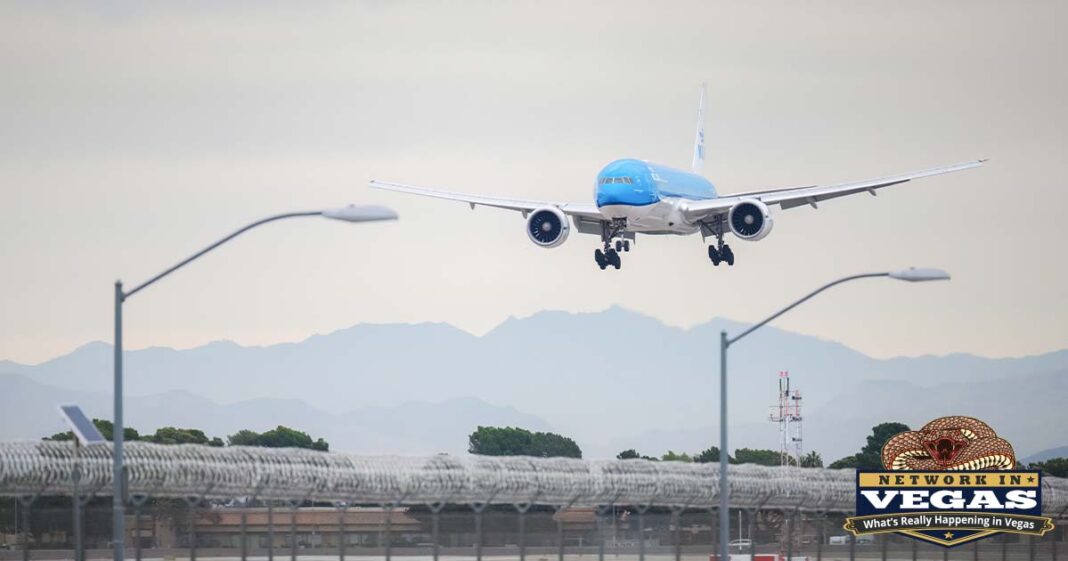
Las Vegas has plenty of attractions designed to separate you from your money. This is not one of them.
Just south of Harry Reid International Airport, formerly known as McCarran International Airport, there is a free public viewing area where you can park only a few hundred feet from the runway and watch passenger jets take off, land and taxi through one of the busiest airports in the country.
Known officially as the Sunset Viewing Area, the small parking lot has long been a favorite hangout for Las Vegas locals, aviation photographers, families and anyone who enjoys watching massive aircraft thunder down the runway.
Get an Up-Close View of the Las Vegas Airport Runways
The viewing area sits alongside the airport’s east-west runways, giving visitors a close look at aircraft arriving and departing throughout the day.
Depending on the wind, runway configuration and time of day, you may see Southwest, Allegiant, Delta, American and United jets, international aircraft, private planes, cargo flights and helicopters.
When planes are landing on the nearby runways, you can sometimes hear the tires hit the pavement and smell the burned rubber as the aircraft slow down. When they are departing, you will feel the engine noise as the pilots push the throttles forward and climb over the Las Vegas Valley.
The experience changes throughout the day, so there is no guarantee which runway will be active or how close each aircraft will be. When airport operations line up correctly, however, this is one of the best free aviation-viewing spots in Las Vegas.
A Great Spot for Plane Spotting and Photography
The Sunset Viewing Area is popular with aviation photographers because it offers unobstructed views of the runway area, taxiing aircraft and planes approaching the airport.
The chain-link security fence can make photography challenging from ground level, so photographers should plan their angles carefully. Visitors must remain an appropriate distance from the fence and stay within the public viewing area.
Lighting is generally better during the morning and late afternoon. Sunset can provide some impressive shots, especially when aircraft are lined up against the mountains, the Strip skyline or the changing colors over the valley.
A flight-tracking app can also help you identify arriving aircraft, see where they came from and determine whether anything unusual is heading toward Las Vegas.
You just might catch a glimpse at some Aliens…
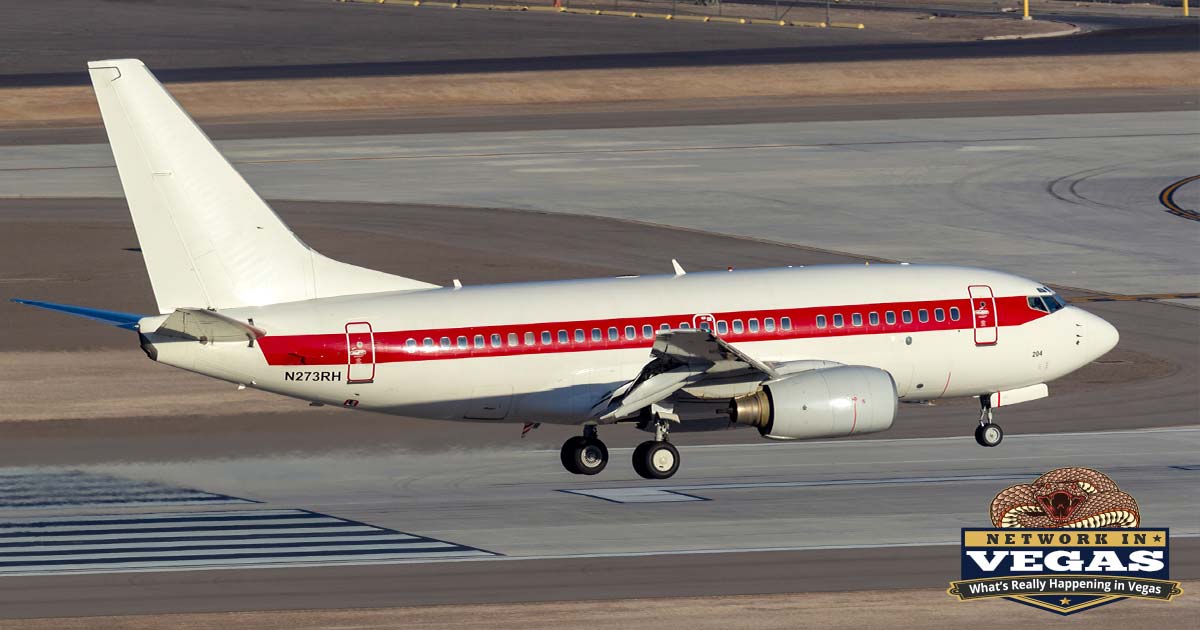
Commercial jets are not the only interesting planes operating from Harry Reid International Airport. Keep an Eye Out for the Mysterious JANET Airlines Aircraft
Sharp-eyed visitors may occasionally spot white Boeing 737s with a red stripe and no traditional airline branding. These aircraft are part of a government-operated transportation service unofficially known as JANET (Just Another Non-Existent Terminal).
The planes are believed to transport government employees and contractors from a private terminal in Las Vegas to restricted military and testing facilities in the Nevada desert, including locations associated with Area 51 and the Tonopah Test Range.
You probably will not see aliens stepping off the plane, but spotting one of these mysterious aircraft adds another uniquely Nevada element to the experience. JANET aircraft continue to operate from a private area of Harry Reid International Airport.
Current Sunset Viewing Area Hours
The viewing area is currently listed as being open seven days a week during the following hours:
April 1 through September 30:
9:00 a.m. to 9:00 p.m.
October 1 through March 31:
9:00 a.m. to 7:00 p.m.
Hours and access can change because of airport operations, maintenance, security concerns or special events. The seasonal schedule was established by the Clark County Department of Aviation when the viewing area reopened and was still being listed in July 2026.
Where Is the Harry Reid Airport Viewing Area?
The Sunset Viewing Area is located off Sunset Road near Escondido Street, between Paradise Road and Eastern Avenue.
The easiest way to find it is to search for “Sunset Viewing Area” or “Las Vegas Airport Runways Viewing Area” in your preferred navigation app.
The approximate GPS coordinates are:
36°04’19.3″N, 115°08’01.3″W
The parking lot is east of Town Square Las Vegas and west of Sunset Park. Parking is free, but the lot is relatively small and can fill during popular viewing times.
Best Time to Visit
Late afternoon and early evening are usually the best times to visit. Temperatures are more comfortable, the light is better for photography and you may be able to watch aircraft against a Las Vegas sunset.
During the summer, avoid the middle of the day whenever possible. The parking area has no shade, and sitting next to the airport pavement during a 110-degree Las Vegas afternoon is not particularly enjoyable.
Flight activity can also vary. Check a live flight-tracking app before leaving to see how many arrivals and departures are scheduled.
Planespotting: What to Bring
The viewing area is a basic parking lot rather than a developed attraction. There are no restrooms, concessions or shaded seating areas.
Bring water, sunscreen and a camera or phone. Folding chairs can make a longer visit more comfortable, but keep them near your vehicle and out of the traffic lanes.
Parents should keep children close. The viewing area is next to an active road, moving vehicles and secured airport property.

Some visitors have traditionally tuned their car radios to 101.1 FM to hear rebroadcast airport communications. Reception and availability can vary, so aviation enthusiasts may prefer using an air-traffic-control streaming service or a properly programmed aviation scanner.
Viewing Area Rules
Visitors are expected to help keep the area safe and open to the public.
Dispose of all trash, do not leave vehicles unattended, remain away from the airfield fence and follow all posted instructions. Never enter restricted airport property or stop along nearby roads when the parking lot is full.
Airport officials specifically warn that loose trash can attract wildlife or create dangerous debris near active runways.
Is the Las Vegas Airport Viewing Area Worth Visiting?
For aviation fans, photographers or families with kids who love airplanes, absolutely.
It is not a polished tourist attraction with a gift shop and snack bar. It is a small parking lot beside an active airport runway. That simplicity is part of what makes it interesting.
You can pull in, park for free and watch enormous aircraft arrive in Las Vegas from cities around the world. Stay for 20 minutes while waiting for someone’s flight, or bring a chair and spend the evening tracking planes as the lights of the Strip begin to come alive in the distance.
In a city where almost everything comes with a cover charge, resort fee or parking fee, the Harry Reid International Airport Sunset Viewing Area remains one of the more unusual free things to do in Las Vegas.
Want to Listen to all the Action
For many avgeeks (spotters/aviation hobbyists), watching the planes is only half the experience. Plane spotters often bring a handheld radio scanner so they can listen to pilots communicating with the control tower as aircraft arrive, depart, taxi between terminals and wait for clearance to take off.
By programming the airport frequencies listed below, visitors can follow communications from the tower, ground control, approach, departure and other airport operations. Hearing a pilot receive landing clearance or being directed toward a runway makes it much easier to understand what is happening around the airport and know which direction the next plane may be coming from.
Recommended Radio Scanners for Plane Spotting
Uniden Bearcat BC125AT Handheld Scanner
The BC125AT is our top recommendation for aviation enthusiasts. It can store up to 500 channels and lets users add names to programmed frequencies, making it easy to identify channels such as Tower, Ground, Approach and Departure on the screen. It receives both civilian and military aviation frequencies and includes Uniden’s Close Call feature for detecting nearby radio transmissions.
Uniden Bearcat SR30C Handheld Scanner
The SR30C is a good lower-cost option for someone who mainly wants to listen to airport communications without paying for more advanced scanner features. It has 500 programmable channels, aviation-band coverage, fast frequency scanning and Close Call technology. Its small size also makes it easy to carry while walking around the viewing area or photographing aircraft.
These radios are receivers, not two-way radios. They allow visitors to listen to airport communications but cannot be used to speak with pilots or air traffic controllers. Reception will depend on your location, the antenna, nearby buildings and which airport frequencies are active at the time.
Harry Reid International Airport Air Traffic Control Frequencies
These frequencies cover air traffic control, approach, departure, tower, ground control, ramp control and airport navigation communications at Harry Reid International Airport.
| Frequency | License | Type | Tone | Alpha Tag | Description | Mode | Tag |
|---|---|---|---|---|---|---|---|
| 130.650 MHz | — | BM | CSQ | AMC Primary | Air Mobility Command Primary | AM | Aircraft |
| 119.400 MHz | — | BM | CSQ | ApproachVHF | Approach and Class B Northeast | AM | Aircraft |
| 379.150 MHz | — | BM | CSQ | Approach UHF | Approach and Class B Airspace North | AM | Aircraft |
| 125.600 MHz | — | BM | CSQ | Approach SW | Southwest Approach | AM | Aircraft |
| 125.050 MHz | — | BM | CSQ | App/Dep | Approach and Departure | AM | Aircraft |
| 125.025 MHz | — | BM | CSQ | App/Dep B | Approach, Departure and Class B Northwest | AM | Aircraft |
| 132.400 MHz | — | B | CSQ | ATIS VHF | Automatic Terminal Information Service | AM | Aircraft |
| 118.400 MHz | — | BM | CSQ | Class B SE | Class B Southeast | AM | Aircraft |
| 353.700 MHz | — | BM | CSQ | Class B Airspace | Class B Airspace Southeast | AM | Aircraft |
| 118.000 MHz | — | BM | CSQ | Clearance VHF | Clearance Delivery | AM | Aircraft |
| 379.950 MHz | — | BM | CSQ | Clearance UHF | Clearance Delivery | AM | Aircraft |
| 257.800 MHz | — | BM | CSQ | Cntl Twr UHF | Control Tower | AM | Aircraft |
| 133.950 MHz | — | BM | CSQ | Dep/ClassBNE | Departure and Class B Northeast | AM | Aircraft |
| 125.900 MHz | — | BM | CSQ | Dep/ClassBSW | Departure and Class B Southwest | AM | Aircraft |
| 307.250 MHz | — | BM | CSQ | Dep/ClassBSW | Departure and Class B Southwest | AM | Aircraft |
| 135.000 MHz | — | BM | CSQ | LAS Final Apprch | Final Approach | AM | Aircraft |
| 122.350 MHz | — | BM | CSQ | Las Vegas FSS | Las Vegas Flight Service Station | AM | Aircraft |
| 133.725 MHz | — | BM | CSQ | LAS Ground Meter | Ground Metering | AM | Aircraft |
| 116.900 MHz | — | BM | CSQ | LAS VOR | Las Vegas VOR Navigation Signal | AM | Data |
| 123.825 MHz | — | BM | CSQ | LAS Helo Control | Las Vegas Helicopter Control | AM | Aircraft |
| 282.200 MHz | — | BM | CSQ | LAS TRACON | Las Vegas Terminal Radar Approach Control | AM | Aircraft |
| 124.625 MHz | — | BM | CSQ | LA Sector 16 | Los Angeles Center Sector 16 High/Low | AM | Aircraft |
| 132.625 MHz | — | BM | CSQ | LA Sector 34 | Los Angeles Center Sector 34 High | AM | Aircraft |
| 124.400 MHz | — | BM | CSQ | LAS Ramp ABC | Ramp Control for A, B and C Gates and Charter/International Ramp | AM | Aircraft |
| 127.900 MHz | — | BM | CSQ | LAS Ramp DE | Ramp Control for D and E Gates and Cargo Ramp | AM | Aircraft |
| 126.975 MHz | — | BM | CSQ | LAS Ramp Meter | Ramp Control Metering | AM | Aircraft |
| 111.750 MHz | — | BM | CSQ | LAS 25L LOC/GS | Runway 25L Localizer and Glide Slope | AM | Data |
| 110.300 MHz | — | BM | CSQ | LAS 25R ILS | Runway 25R Instrument Landing System | AM | Data |
| 118.750 MHz | — | BM | CSQ | LAS Twr 01/19 | Tower for Runways 01/19 | AM | Aircraft |
| 119.900 MHz | — | BM | CSQ | LAS Twr 08/26 | Tower for Runways 07/25 | AM | Aircraft |
| 270.800 MHz | — | BM | CSQ | LAS Grnd E 01/19 | UHF Ground Control East of Runways 01/19 | AM | Aircraft |
| 254.300 MHz | — | BM | CSQ | LAS Grnd W 01/19 | UHF Ground Control West of Runways 01/19 | AM | Aircraft |
| 120.450 MHz | — | BM | CSQ | LAS VFR Final | VFR Final Approach | AM | Aircraft |
| 121.100 MHz | — | BM | CSQ | LAS Grnd E 01/19 | VHF Ground Control East of Runways 01/19 | AM | Aircraft |
| 121.900 MHz | — | BM | CSQ | LAS Grnd W 01/19 | VHF Ground Control West of Runways 01/19 | AM | Aircraft |
Harry Reid International Airport Airline Operations Frequencies
These frequencies are used by airlines, aircraft maintenance crews, dispatchers, fixed-base operators and other aviation services operating at the airport.
| Frequency | License | Type | Tone | Alpha Tag | Description | Mode | Tag |
|---|---|---|---|---|---|---|---|
| 132.000 MHz | — | BM | CSQ | ASA Ops | Alaska Airlines Operations | AM | Aircraft |
| 129.820 MHz | — | BM | CSQ | AAY Ops | Allegiant Air Weight and Balance | AM | Aircraft |
| 129.200 MHz | — | BM | CSQ | AAL Maint | American Airlines Aircraft Maintenance | AM | Aircraft |
| 131.775 MHz | — | BM | CSQ | AAL Ops | American Airlines Operations | AM | Aircraft |
| 128.850 MHz | — | BM | CSQ | Atlantic | Atlantic Aviation Ramp | AM | Aircraft |
| 131.450 MHz | — | BM | CSQ | DAL Ops | Delta Air Lines Operations | AM | Aircraft |
| 118.700 MHz | — | BM | CSQ | EGG Janet | JANET Operations, Callsign “Gold Coast” | AM | Aircraft |
| 131.925 MHz | — | BM | CSQ | FDX Ops | Federal Express Operations | AM | Aircraft |
| 130.075 MHz | — | BM | CSQ | FFT Ops | Frontier Airlines Operations | AM | Aircraft |
| 136.600 MHz | — | BM | CSQ | JBU Ops | JetBlue Airways Operations | AM | Aircraft |
| 128.900 MHz | KPF7 | BM | CSQ | SF Radio | San Francisco Radio ARINC | AM | Aircraft |
| 128.875 MHz | — | BM | CSQ | Signature | Signature Flight Support | AM | Aircraft |
| 129.175 MHz | — | BM | CSQ | SWA Deice | Southwest Airlines Deicing | AM | Aircraft |
| 131.700 MHz | — | BM | CSQ | SWA Disp | Southwest Airlines Dispatch | AM | Aircraft |
| 131.875 MHz | — | BM | CSQ | SWA Ops | Southwest Airlines Operations and Maintenance | AM | Aircraft |
| 130.525 MHz | — | BM | CSQ | Spirit Airlines | Spirit Airlines Operations | AM | Aircraft |
| 130.750 MHz | — | BM | CSQ | Sundance 1 | Sundance Helicopter Ramp Coordination | AM | Aircraft |
| 129.600 MHz | — | BM | CSQ | Sundance 2 | Sundance Helicopters | AM | Aircraft |
| 129.775 MHz | — | BM | CSQ | Swissport | Swissport Operations | AM | Aircraft |
| 129.500 MHz | — | BM | CSQ | UAL Ops | United Airlines Operations | AM | Aircraft |
Radio frequencies and airport assignments can change. Confirm current information before programming a scanner.
Track Flights Over Las Vegas with Flightradar24
A radio scanner lets you hear pilots and air traffic controllers, while Flightradar24 helps you see where the aircraft are in real time. The website and mobile app display planes on a live map, making it easy to identify aircraft approaching or departing Harry Reid International Airport.
Tap or click on an aircraft to view available details such as the flight number, airline, origin, destination, aircraft type, altitude, speed and flight path. This is especially useful for plane spotters who want to know what is coming in next, where a flight is arriving from or whether an unusual aircraft is heading toward Las Vegas.
Using Flightradar24 together with the airport scanner frequencies gives you a much better picture of what is happening around the runways. You can watch an aircraft move across the map while listening for its call sign on approach, tower or ground-control frequencies.
Keep in mind that not every aircraft will appear. Coverage, aircraft equipment, privacy restrictions and government operations can affect what is displayed.
View live flights at Harry Reid International Airport on Flightradar24:
https://www.flightradar24.com/airport/las