
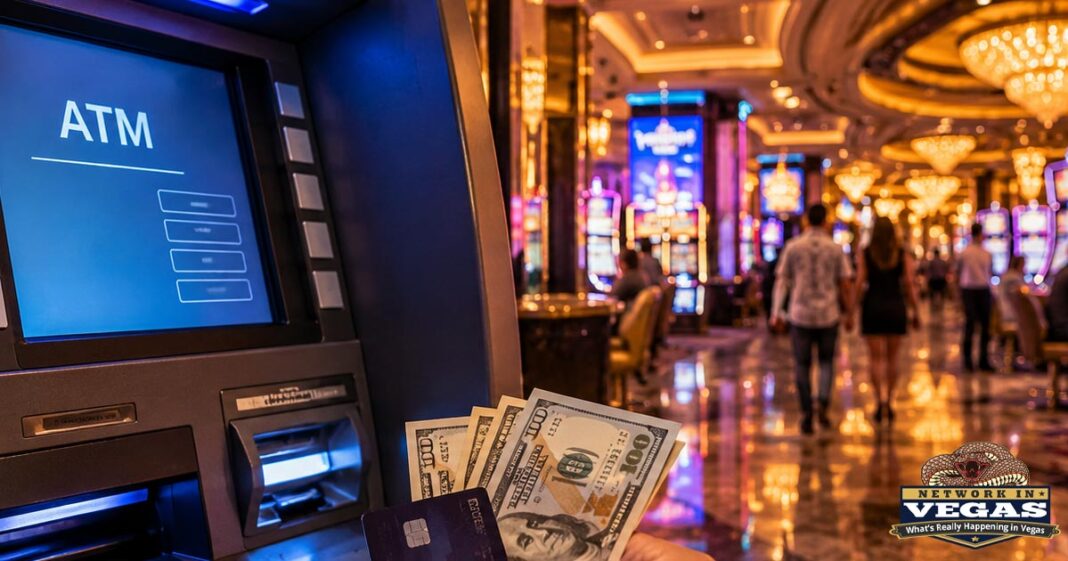
Las Vegas has no shortage of places willing to take your money. Getting cash out of your own bank account shouldn’t be one of the expensive parts of the trip, but use the wrong ATM on the Strip and you can pay almost as much in fees as you would for a cheap lunch. The worst part is that the fee printed on the ATM screen may not even be the whole charge. Your own bank could add another one when the transaction posts.
You don’t have to spend your vacation driving around town looking for a bank, and you don’t necessarily have to carry your entire gambling budget in your pocket. You do, however, need to know which machines to avoid and where to look before you hit that withdrawal button.
How much do Las Vegas casino ATMs charge?
There isn’t one standard fee. Each operator sets its own charges, and those charges can vary by casino, machine and withdrawal amount. Caesars Entertainment’s published Las Vegas ATM guidance says its Fast Cash machines start at $9.99, with higher charges depending on how much you withdraw. That alone can turn an ordinary cash stop into a lousy deal, especially if you’re taking out small amounts more than once.
Other ATMs can cost less. In an August 2026 survey of Las Vegas Strip ATMs, Las Vegas Then and Now reported a $3 ATM fee at Casino Royale, making it the cheapest casino machine the site found on its walk-through. The same survey found roughly $3 fees at some convenience-store ATMs, including locations such as CVS, Walgreens and Target. Those are observations from that survey, not guaranteed rates: casino operators can change prices, and the machine’s own disclosure is the final word before you authorize a withdrawal.
There may also be a second fee from the bank or credit union that issued your debit card. If an ATM charges $9.99 and your bank assesses a $3 out-of-network fee, getting $100 can cost you $12.99. That’s almost 13% of the cash you just took out, before you’ve played a single hand.
Where to find cheaper cash on the Las Vegas Strip
Convenience stores are often the first place worth checking. When you’re near a CVS, Walgreens or Target, look at the ATM before walking into the nearest casino just because it’s more convenient. Some retail machines have considerably smaller surcharges than machines on casino floors. That said, a store name doesn’t guarantee a specific fee, and one chain can have machines belonging to different networks or operators.
Casino Royale is worth a look if you’re near that part of the Strip. It was listed at $3 in the August 2026 on-the-ground survey cited above. Treat the figure as a useful lead, not a promise that the rate is still $3 on the day you visit.
Your own bank’s locator is the safest place to start. If you bank with a major national institution, search its app for a nearby in-network ATM. Even if the closest one isn’t inside your resort, it may be worth using on the way to dinner or before you reach the Strip. Not every bank-branded machine is free to every cardholder, so look for your own institution or an eligible partner network.
You might be able to get cash without an ATM surcharge
A lot of visitors overlook the ATM networks their banks already belong to. Allpoint operates more than 55,000 surcharge-free ATMs worldwide for customers of participating financial institutions. Its locations include retail stores such as CVS, Walgreens and Target, with a searchable locator you can check before leaving your hotel. Credit unions may also offer access through CO-OP or other shared ATM arrangements.
Here’s the catch: a machine being part of Allpoint doesn’t make it free for everybody. Your bank, credit union or card provider has to participate. Check your account benefits and use the network locator to confirm the exact machine. Allpoint says its locator is updated weekly, which makes it much more useful than an old blog post promising a free ATM at a location that may have changed operators.
Find participating machines through the Allpoint ATM locator. Credit union members can also check their institution’s website for a shared-branch or surcharge-free ATM finder. Don’t assume every credit union ATM belongs to your particular network.
Is getting cash back at a store cheaper?
Sometimes. When you make a debit-card purchase at a store that offers cash back, you can request cash along with the purchase rather than use an ATM. Many stores impose limits on how much cash you can request, and some may charge a fee or restrict the types of cards they accept. Ask at checkout before buying something just to get cash.
For someone who only needs $20 or $40 for tips, a purchase with cash back can make more sense than paying a large casino ATM fee. For someone who needs several hundred dollars, a low-limit cash-back transaction probably isn’t a workable substitute. You’ll also want to avoid buying merchandise you don’t need merely to avoid a modest withdrawal charge.
Watch out for cash advances at casinos
A regular debit-card ATM withdrawal and a credit-card cash advance are not the same thing. Taking cash against a credit card can trigger a cash-advance fee and interest under your card agreement, often without the grace period that applies to ordinary purchases. Casino cash-access services may have their own transaction charges as well.
If an ATM or kiosk presents an option to get cash using a credit card, read the terms carefully. Don’t assume the rate will be similar to a debit withdrawal just because you’re standing at the same machine. And if you’re withdrawing from a checking account, make sure you’re selecting the appropriate debit transaction rather than an expensive cash-advance product.
What about taking out more cash in one withdrawal?
A single withdrawal can cost less than several smaller ones when the ATM charges a flat fee. Imagine a machine that charges $8 per transaction: four $100 withdrawals would cost $32 in machine surcharges, while one $400 withdrawal would cost $8. But that math only works if the fee really is flat, the machine allows the larger withdrawal and your bank doesn’t impose other charges. Some casino machines have fee tiers tied to the amount of cash requested.
There is also a practical downside to carrying more cash than you’re comfortable losing. Decide on a gambling budget before going to the casino, keep spending money separate, and don’t withdraw more just because it makes the fee percentage look smaller. Paying one unnecessary $8 fee is better than making an impulsive $500 withdrawal you hadn’t planned on.
A simple plan before you go out
If you’re flying into Las Vegas, check your banking app for surcharge-free ATMs before traveling and consider getting cash from your own bank at home. Once you’re here, use your financial institution’s locator, then check nearby stores before settling for a casino machine. Pay attention to the ATM’s displayed charge, your bank’s out-of-network fees and the maximum amount you’re permitted to withdraw. Some accounts reimburse ATM fees, but reimbursement rules and monthly limits vary.
If you’re already on the Strip and need cash immediately, the decision is straightforward: compare the fee on the machine in front of you with another realistic option a short walk away. Saving $7 is worthwhile if the lower-cost machine is nearby. Spending an hour of your vacation chasing a $3 surcharge probably isn’t.
Las Vegas has plenty of unavoidable expenses, but paying double-digit fees for access to your own money doesn’t have to be one of them. A minute spent checking your bank’s network can save more than wandering around a casino hunting for a supposedly cheap ATM.