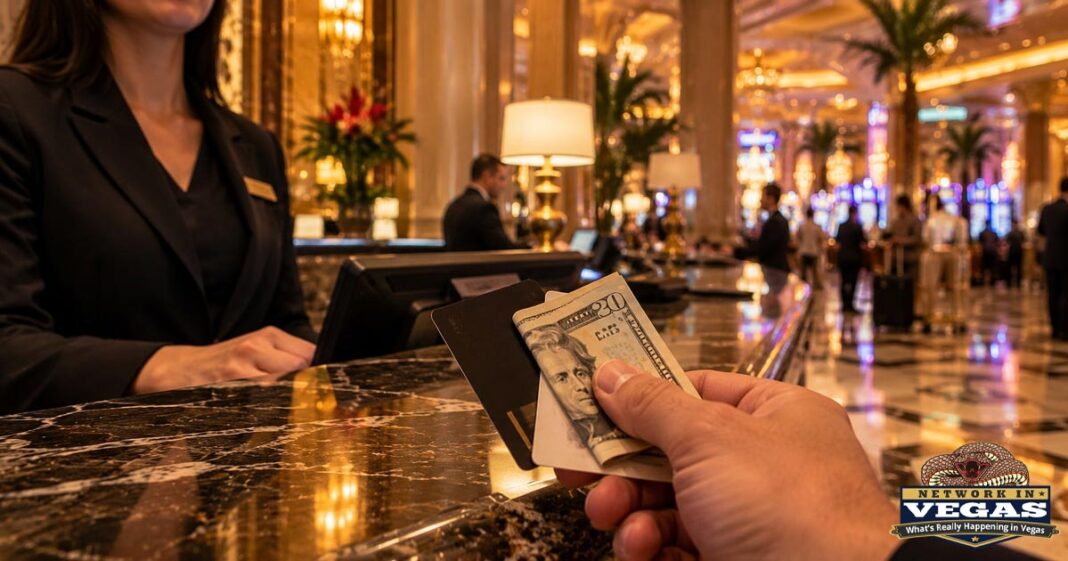
If you’ve spent any time reading Las Vegas travel forums, you’ve probably heard about the $20 trick. The pitch is simple: tuck a twenty-dollar bill between your driver’s license and credit card when you check into a hotel, ask about complimentary upgrades, and hope the person behind the counter swaps your basic room for something better. People have been talking about it for years, and there are plenty of stories about it working. There are also plenty about the clerk handing the money right back.
So does it still work in 2026? Sometimes. But the important part isn’t the folded bill. It’s whether the hotel has a better room available, whether the employee can assign it, and whether the room is one the hotel is willing to give away. If you walk up to the desk at a sold-out Strip resort expecting a suite for twenty bucks, you’re probably going to be disappointed.
What exactly is the Vegas $20 trick?
The classic version is sometimes called the sandwich trick. At check-in, a guest puts a $20 bill between an ID and a credit card and hands the stack to the desk agent while asking whether there are any complimentary upgrades available. The cash is meant as a tip for the employee’s help. Some travelers use $40 or $50 instead, especially at expensive properties, but there’s no published tipping schedule that determines which room you’ll receive.
Here’s the part that tends to get lost in online discussions: this is not an official hotel program. A hotel doesn’t promise an upgrade because someone hands over cash, and individual employees may have different rules about accepting tips. The employee might offer a better room, quote a paid upgrade, return the money, or simply tell you nothing else is available. Don’t assume the tip will automatically be returned if an upgrade doesn’t happen; be clear about what you’re offering and ask before handing it over if you’re uncomfortable with that possibility.
Does the $20 trick actually work in 2026?
There are credible traveler anecdotes in both directions, but anecdotes aren’t a success rate. Las Vegas Advisor has documented reports of people getting upgrades and reports of desk clerks declining the cash or returning it because they couldn’t help. More recent guides continue to describe mixed results. None of that establishes that the trick works at a particular hotel on a predictable percentage of visits.
The clearest indication of how hotel upgrades work comes from the hotels’ own terms. Wynn’s promotional terms describe certain room upgrades as subject to availability and casino-host discretion. Marriott Bonvoy’s MGM Collection terms similarly describe eligible elite-member room upgrades as subject to availability on arrival. Those provisions aren’t policies about the $20 trick, but they demonstrate something useful: even recognized upgrade benefits have limits. A tip doesn’t erase those limits.
What has also changed is how many guests check in. Mobile check-in, digital room keys and self-service kiosks are common enough that some visitors never deal with a human at the desk. You can’t slip a bill to an app, and hunting down an employee just to try a trick makes a lot less sense than it did when everyone stood in the same check-in line.
What kind of hotel upgrade could you realistically get?
A meaningful upgrade doesn’t have to be a giant suite. Suppose you booked the cheapest room category in a big Strip hotel. The realistic improvement might be a higher floor, a Strip-facing view instead of a view of the parking structure, a room farther from the elevators, or a better room within the same general category. Those changes can make a stay more pleasant, particularly if you’re spending several nights in the room.
A suite is a different proposition. Hotels sell larger rooms at higher rates for a reason, and premium inventory may be reserved for paying guests, loyalty members or casino customers. That doesn’t mean a suite upgrade is impossible. It means that the person who claims a $20 bill reliably turns entry-level rooms into luxury suites is selling a story, not a dependable booking strategy.
Before you offer anything, decide what you would actually value. A better view might be worth more to you than a larger room overlooking a service road. If two queen beds are essential, don’t trade them for an upgraded king room just because someone describes it as a better category.
When are your chances better?
Room availability is the big variable. Las Vegas hotels can have completely different occupancy patterns depending on conventions, concerts, major sporting events, holidays and the day of the week. A quiet stretch with plenty of unoccupied rooms gives staff more options than a packed weekend when the resort is trying to fit every reservation into the rooms it has.
That doesn’t mean Tuesday always works or that Sunday is a magic day. CES, SEMA, major fights and other events can bring huge crowds to town outside the usual Friday-and-Saturday rush. If your trip overlaps a major show, check the Las Vegas convention calendar before assuming a weekday will be slow. And don’t count on a specific check-in hour as a guaranteed strategy: arriving early might mean the better rooms aren’t ready, while arriving late might mean they’ve already been assigned.
It also matters how long you’re staying. Giving away an available room for one night is different from committing it to somebody for five nights. The hotel has to consider inventory over your entire stay, not just the evening you arrive.
Should you use $20, $50 or $100?
You’ll find websites prescribing different amounts based on the hotel: twenty bucks at a budget property, fifty at a midrange resort and a hundred at a luxury hotel. Treat those figures as other people’s opinions, not proven rules. There isn’t a verified chart showing that one amount reliably produces a particular room at Bellagio, Caesars Palace, Wynn or any other major property.
The bigger the tip, the more important it becomes to compare it with the cost of buying the upgrade outright. If a better room costs $30 more per night and you’re staying one night, offering $50 at the desk makes little financial sense. On the other hand, a view upgrade costing $40 per night over four nights has a different value to the traveler. Look at the actual price before gambling on a tip.
A better way to ask for an upgrade
You don’t need to hide cash between your cards. Ask the agent whether any complimentary upgrades are available for your stay. If they say no, ask what a better view or larger room would cost. Sometimes a specific request is more useful than the vague phrase “any upgrades?” because the agent knows what you want and can check the appropriate room category.
If you want to tip someone for helping, do it openly and politely, subject to the hotel’s rules. Don’t make it a demand, don’t pressure an employee who declines, and don’t invent a honeymoon or anniversary story. A friendly check-in conversation may get you nowhere, but it also costs nothing to ask.
The most useful question is often: Are there any better-view rooms available, and what would the price difference be? It gives you the information you need to make a decision without pretending there’s some secret loophole in the hotel’s reservation system.
Casino players and loyalty members have another route
Someone who regularly gambles at a particular casino may have access to room offers or a casino host. Loyalty benefits can also matter. Under published Marriott Bonvoy MGM Collection terms, eligible Platinum Elite members and higher may receive enhanced-room upgrades when available, with some higher-tier benefits extending to suites. The details depend on the program and property, and not every room or member qualifies.
Don’t mistake that for a reason to spend hundreds of dollars gambling to chase a free room upgrade. If you already have status or existing offers, use them. If you don’t, compare the cost of booking the room you want against the value of any supposed free benefit.
What about tipping when the trick fails?
Stories about the $20 trick often say the agent will hand back the bill if no upgrade is possible. That does happen, but it is not a guarantee or a standard published rule. A tip may be accepted even if no change to the room is offered, or the employee may decline to take it at all. You should never rely on getting the money back as the reason the maneuver is supposedly risk-free.
And remember that an upgrade does not necessarily erase a resort fee, parking charges or other hotel costs. Those are separate parts of your reservation. If you want to understand the rest of the bill before check-in, read our guide to what Vegas hotels still offer free and compare total prices rather than the advertised room rate alone.
Is the $20 trick worth trying?
It can be, provided you understand the odds are unknown and you aren’t counting on a particular outcome. If your room is already booked, you’re satisfied with what you paid for, and an employee is able to offer you something better, great. But don’t show up expecting a suite because a TikTok video says a folded twenty is all it takes.
For most visitors, the smarter play is less exciting: book a room you’d be happy to stay in, check the price of an upgrade before the trip, and ask politely at check-in. If you get something extra, consider it a bonus. If you don’t, at least your Vegas vacation doesn’t begin with an argument over a twenty-dollar bill.