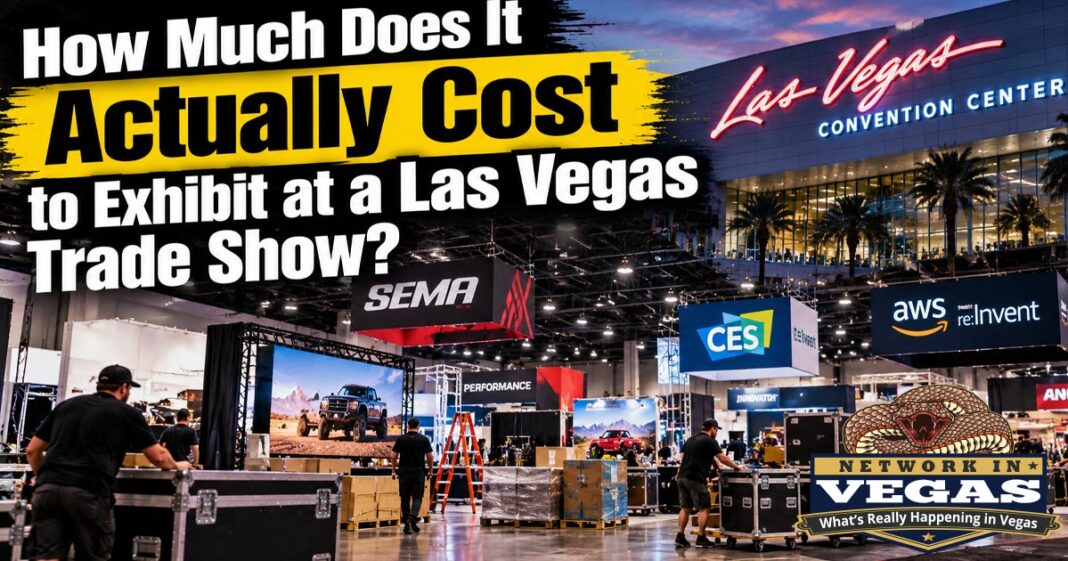
For a single 10×10 at a mid-size Las Vegas show, a realistic planning range is somewhere around $16,000 to $60,000 all-in. The booth space is usually the cheapest surprise on the bill.
The number on the show’s sales sheet is the one everybody budgets for. Then the exhibitor services manual shows up and you find out about material handling minimums, union labor, a $150 electrical outlet, a carpet you didn’t know you had to rent, and a separate deadline for basically everything. First-timers get hit hardest, because nobody tells you which of these charges you can avoid until you’ve already paid them.
So here’s where the money goes, what you can skip, and how to figure out whether the whole thing is worth it.
The booth space
Floor space prices swing a lot, and it’s mostly the show, not the city. A few 2026 Las Vegas examples:
- The Academy of General Dentistry’s 2026 show listed a 10×10 inline at $2,900 and a corner at $3,500.
- The ASI pavilion at PRINTING United Expo (LVCC, September) charged $4,000 per 10×10, plus a required $1,000 annual membership.
- RE+ 26 at the Las Vegas Convention Center this November lists a base rate of $52 per square foot, so $5,200 for a 10×10, with member and sponsor discounts down to $42.
- NAMB National at Caesars Palace priced a 10×10 at $7,495, but that bundles a skirted table, chairs, ten staff badges and the attendee list.
That last one is the point. Read what’s included. NAMB throws in furniture and badges. Plenty of shows don’t. NACCHO’s 2026 package flat out excludes carpet, electrical and lead retrieval, and charges $650 to $850 for each extra booth staff badge depending on when you register. Notice the corner premium at AGD too. Corners and spots near the entrance often cost more, and they’re usually worth it.
The booth itself: rent or buy?
If you’re doing one or two shows a year, rent. A basic 10×10 rental in Las Vegas generally runs $2,000 to $6,000 depending on what’s bundled. Buying a simple modular kit can come in under that, but then you own the storage problem, the shipping problem and the “this looked fine three years ago” problem. Custom builds for bigger footprints start around $10,000 and climb fast.
Buying starts making sense when you’re hitting four or more shows a year with the same footprint, or when you’re doing several Vegas shows and can keep the booth in local storage between them instead of shipping it home every time. That storage is its own monthly line item, so price it out.
Signage and graphics
This is the line people underspend on, and then wonder why nobody stops.
According to ConventionSigns.com, a sign shop a few minutes from the Las Vegas Convention Center, basic retractable banners start around $150 to $350, and full booth wraps and large backdrops run from about $800 into the several-thousands. Standard turnaround is three to seven business days, with rush options.
The bigger issue is what happens to graphics in transit. Every show season, local shops get the same calls: a panel arrived cracked, a backwall printed at the wrong dimensions for the frame, a product changed and the signage didn’t, or the crate just never showed up. During SEMA or CES week, finding someone in town who can reprint and install overnight is the difference between a booth and a bare frame. ConventionSigns, for example, tells SEMA exhibitors to get orders in by October 20 for standard turnaround and to call for last-minute jobs.
Printing locally also cuts inbound freight and the risk of damage. It doesn’t automatically get you out of material handling, though. If a local shop delivers to the dock or the advance warehouse, it’s freight like anything else. If they deliver something you’re allowed to hand-carry, or install it themselves as an approved contractor, that can change. Ask how they deliver and check your show’s rules.
One more correction to common advice: hanging signs are great, but they’re mostly a bigger-booth thing. Many shows prohibit overhead signage in standard inline booths, and where it’s allowed, rigging goes through the official contractor and gets ordered separately. For a 10×10, put the money into a backwall people can read from 20 feet away and a counter wrap that stays visible when the booth fills up.
Shipping, material handling and the minimums that get you
Getting your stuff to Las Vegas is one bill. Getting it from the loading dock to your booth is a completely different one. A lot of first-time budgets include the second and forget the first, or the other way around.
Material handling (drayage) covers unloading, delivery to your booth, storing your empty crates during the show and bringing everything back out. It used to be billed almost entirely per hundredweight (100 pounds), and more shows are now moving to per-pound pricing. CES material handling has been running roughly 71 cents a pound at the LVCC, and CES says rates for 2027 are flat from 2026. Industry-wide, $90 to $200-plus per hundredweight is a normal range, and some larger exhibits are seeing more.
Here’s what catches people:
There are minimums. A lot of shows charge a 200-pound minimum per shipment, and weights get rounded up, not down, so a 506-pound crate can bill as 600. Every separate shipment can trigger its own minimum. Three boxes arriving from three different senders on three different days means three charges. One exhibitor manual for a Vegas hotel show spells it out plainly: use the contractor’s equipment to move your stuff and you pay a $175 minimum plus fees.
Packing matters. Crated, skidded freight is cheapest to handle. Loose boxes, pad-wrapped items and anything needing special handling can cost more on shows that still use those categories.
Timing matters. Freight that misses the advance warehouse deadline or shows up outside your assigned target window usually costs more. Overtime handling charges are common too.
Warehouse versus direct. Shipping to the advance warehouse means your freight is sitting in your booth when you arrive, but you have to hit a deadline weeks out. Shipping direct to the convention center works for last-minute stuff, but it has to arrive in a narrow window, and if your truck’s late, you’re setting up late. Pick based on your schedule, not just the rate sheet.
The cheapest option, when it’s allowed, is hand-carry. At the LVCC, exhibitors can bring materials in themselves as long as full-time company employees do the carrying and nobody uses material-handling equipment. That means no hand trucks, no dollies, no four-wheel carts. Lightweight luggage carts and pop-up displays in rolling cases are generally fine. Unloading happens from the parking lots, and only pickups and passenger vans qualify. Rules differ by show and by venue, and some shows are stricter, so read the manual before you load the van. For a small company with a pop-up and a few boxes, getting this right can save several hundred dollars on what would otherwise be a minimum-charge shipment.
Labor, electrical and the rest of the services list
Can you set up your own booth at the Las Vegas Convention Center? For a small booth, usually yes, as long as it’s your own full-time employees doing it and you’re not using power tools or touching electrical beyond plugging in. Anything involving rigging, forklifts, running power or bigger structures goes through union labor, which generally bills somewhere around $120 to $250 an hour, with overtime well above that.
Electrical sounds cheap until you see the per-outlet price. A standard 500-watt outlet has run around $100 at the advance rate and closer to $150 ordered on site, plus labor if anything needs to be run under the carpet.
Then there’s the stuff that’s easy to forget because it’s spread across a dozen order forms:
| Service | What to know |
|---|---|
| Internet | Don’t count on the public Wi-Fi for demos or card payments. A dedicated connection is its own order, often with its own early deadline. |
| AV and monitors | Screen rentals, mounts and tech support add up from a few hundred to a few thousand. Bringing your own screen means shipping and handling it. |
| Booth cleaning | Nightly vacuuming and trash removal are often separate charges. |
| Lead retrieval | Scanning badges through the show’s system usually costs extra per device or app license. |
| Carpet and furniture | Often required, rarely included. |
| Insurance | Many shows require general liability coverage and certificates of insurance, especially if you hire outside contractors. |
| Food and drinks | Convention centers usually have an exclusive caterer, so handing out coffee or snacks in your booth may mean ordering through them. Feeding your own staff for four days isn’t free either. |
And watch the deadlines, plural. RE+ this year had separate discount cutoffs for internet and catering (October 6), the general contractor’s discount deadline (October 15) and a freight questionnaire (October 15). Each one you miss costs more. Advance rates versus show-site rates is one of the biggest controllable swings in the whole budget.
Travel and the Vegas-specific stuff
Hotels during big show weeks get expensive, and the room rate isn’t the whole bill. Most Strip properties add a nightly resort fee, plus paid parking. Three people for four nights adds up quickly once those are in. Factor in rideshares (closing-time lines at the LVCC can be brutal, so the Monorail’s worth knowing), meals and the coffee you’ll buy at $7 a cup because you can’t leave the booth.
What a bigger booth really costs
Doubling your space almost always more than doubles your spend. At RE+’s $52 base rate, a 10×20 is $10,400 and a 20×20 is $20,800 just for floor space. NAMB’s pricing ran $11,995 for a 10×20 and $25,000 for a 20×20 island.
But the space is the easy part. A bigger booth means more freight and more material handling, longer install and dismantle times that probably require union labor, larger graphics, lighting, more electrical, more furniture, more staff, and likely rigging if you want a hanging sign (which is where those finally make sense). Island booths also tend to need custom structures and storage between shows. Expect a 20×20 to land in the six figures once everything’s counted, and that’s before you’ve fed anyone.
The money you spend before anyone walks in
A company can spend $30,000 building and staffing a booth and do absolutely nothing to get the right people to it. That’s the most common way trade show money gets wasted.
The buyers you actually want plan their week before they land. If you wait until the show opens to reach out, you’re fighting every other booth for their leftover 15 minutes. So budget for the work that happens beforehand: an email campaign to existing customers and prospects with your booth number and a real reason to stop by, scheduled appointments, invitations to your dinner or event, a press release if you’re launching something, and printed materials. Some shows also sell sponsored listings, email blasts or new-product showcases.
None of that is expensive compared to the booth. It’s just usually the first thing cut. And a lot of the best meetings you set up beforehand won’t happen on the floor at all.
After-hours: where the deals actually happen
If you have to cut something to make the numbers work, don’t cut this.
Plenty of Las Vegas business never touches the show floor. It happens over a client dinner near the convention center after the hall closes, in a hospitality suite, or at a party that wraps up the week. CES even sells hospitality suites at hotels like the Bellagio, Vdara and Westgate as an alternative to floor space, though the exhibitor still pays room, tax, resort fees, food, drinks and gratuities on top.
Robert Richardson of Richardson Marketing, a Las Vegas firm that works with exhibitors every show season, thinks most companies get the split backwards.
“Most exhibitors put every dollar into the booth and then go back to the hotel at five o’clock. The booth gets you a badge scan. The dinner, the suite, the after-party, that’s where somebody sits down and tells you what their problem actually is and what they’d pay to fix it. We tell clients to set aside real money for after-hours and to brand it like they’d brand the booth, because those are the leads that close.”
Branding it is cheap. A banner at the door of your suite, a step-and-repeat at your party and a few table signs cost a few hundred bucks, and every photo a guest posts carries your logo for free.
Book early, too. Private dining rooms go first during big show weeks, and if you’re hosting an official event through the show, there are usually separate deadlines and security rules.
A sample 10×10 budget
So how much should you budget for a trade show? Here are rough numbers for one 10×10 at a mid-size Las Vegas show with a three-person team. These are planning estimates built from the ranges above. Swap in your show’s actual rate sheet.
| Line item | Low | High |
|---|---|---|
| Booth space | $3,000 | $7,500 |
| Booth display (rental) | $2,000 | $6,000 |
| Graphics and signage | $500 | $3,000 |
| Shipping to and from Las Vegas | $500 | $2,500 |
| Material handling | $200 | $1,000 |
| Install/dismantle labor | $0 | $2,000 |
| Electrical | $100 | $300 |
| Carpet, furniture, cleaning | $500 | $2,000 |
| Internet, AV, lead retrieval | $500 | $3,000 |
| Insurance (if not already covered) | $0 | $500 |
| Travel, hotel, resort fees, parking, meals | $4,000 | $9,000 |
| Pre-show marketing | $500 | $5,000 |
| After-hours dinners and events | $2,000 | $10,000 |
| Contingency (15–20%) | $2,100 | $10,400 |
| Total | ~$16,000 | ~$62,000 |
The low end assumes a cheaper show, hand-carry, self-setup and a couple of client dinners. The high end is a pricier show where you ship freight, hire labor, rent screens and actually host something.
Is it worth the money?
Most exhibitors never do this math, and it’s not hard.
Figure out what you actually make from a new customer (profit, not revenue). Divide your total show cost by that number and you’ve got the number of customers you need just to break even. Then divide that by your lead-to-customer conversion rate to see how many qualified leads you need to walk out with.
Say the show costs you $30,000 all-in. A new customer is worth $5,000 in profit, and you typically close 20 percent of qualified leads.
| Total show cost | $30,000 |
| Profit per customer | $5,000 |
| Customers needed to break even | 6 |
| Lead-to-customer conversion | 20% |
| Qualified leads needed | 30 |
| Cost per qualified lead | $1,000 |
Thirty real conversations with real buyers in three or four days is very doable at a good show. It’s not doable if you’re counting on people to wander by. That’s why the pre-show outreach and the after-hours stuff matter so much: that’s where most of those 30 come from.
This is deliberately simple. It ignores repeat business, referrals and the stuff that’s hard to price, like meeting a distributor or getting press. But if you can’t make the basic numbers work on paper, a nicer booth won’t fix it.
Where to start
Get the exhibitor services manual the day you sign, not the month before. Put every discount deadline on the calendar. Figure out whether you qualify for hand-carry before you pay to ship anything. Lock your pre-show outreach and your after-hours plan before you finalize the booth. And get graphics quoted locally, both to cut freight and so you’ve got someone in town when a panel shows up broken. ConventionSigns.com handles printing, delivery and installation for exhibitors at the LVCC, Venetian Expo, Mandalay Bay and the hotels, including rush jobs during show week.