
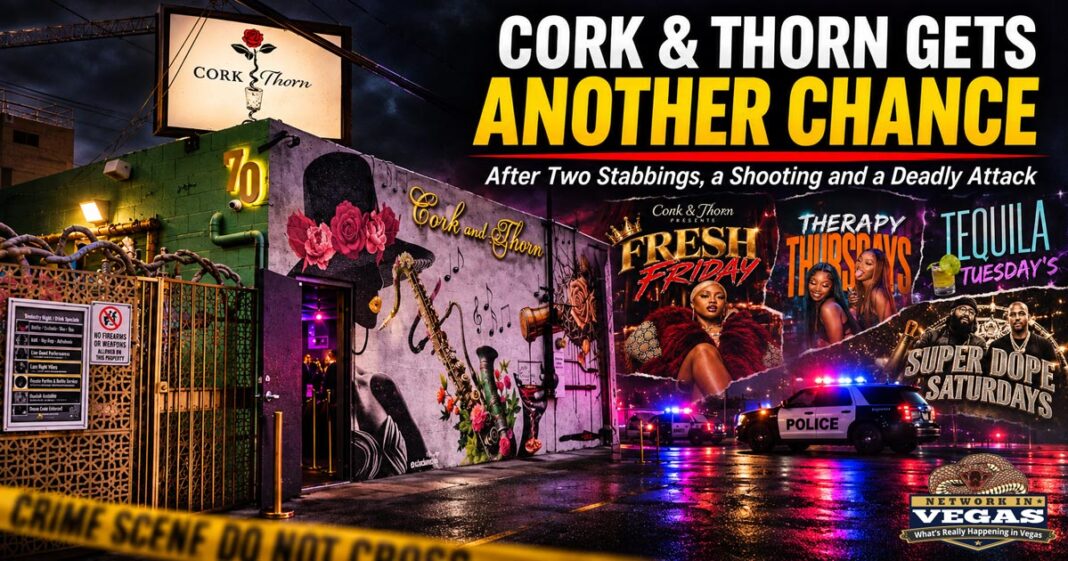
Two stabbings, a shooting that cost a man his leg, a murder, and allegations that nightclub security personnel tried to destroy evidence. After hearing all of that, the Las Vegas City Council decided the solution was to make Cork & Thorn close at 1 a.m. Meanwhile, the city continues to struggle with violence across downtown and the Strip, and the people paying the price are the businesses and residents trying to keep Las Vegas alive.
On Wednesday, November 4, the Las Vegas City Council spent hours hearing testimony about the violence surrounding Cork & Thorn, a nightclub in the Arts District. Metro laid out a history of three serious incidents in a city-owned parking lot near the business, including two stabbings, a shooting that left a man without a leg, and allegations that nightclub security personnel collected shell casings to conceal their involvement in gunfire. One man is dead, another is permanently disabled, and according to police, the incidents began with disputes inside the club before spilling into the parking lot.
After hearing all of that, the council voted to let Cork & Thorn remain open. The new punishment? Close at 1 a.m., end live entertainment at midnight, temporarily suspend hookah service, and return in February so the city can decide whether everything is going better.
Apparently, that’s what passes for protecting public safety in Las Vegas these days. And if the council wanted to send a message to the other businesses trying to survive in the Arts District, it certainly sent one.
The landlord, Gary Creagh, apparently had a different opinion. He asked the city to permanently close the establishment, and owner Randi Garrett says he’s now evicting her. A private property owner looked at what was happening around his building and decided he’d had enough. The city, which happens to own the parking lot where the violence occurred, decided another chance was in order.
Three Violent Incidents, Repeated Warnings and a City That Kept Allowing the Club to Reopen

The problems at Cork & Thorn didn’t begin with September’s fatal stabbing. According to testimony presented by Metro, the city had been dealing with serious incidents associated with the establishment for months.
March 14, 2026: Police responded to what was initially reported as a shooting. According to testimony, a fight began inside Cork & Thorn before spilling into the parking lot, where someone reportedly displayed a gun and another man was stabbed. The stabbing victim initially believed he’d been shot. City licensing officials later cited the business for failing to immediately notify police, issuing a notice of non-compliance and requiring corrections. Despite the warning, operations continued.
May 2026: Another argument inside the business led to gunfire outside, this time with devastating consequences. One man suffered injuries so severe that his leg had to be amputated. Metro Lt. Zachary Burns told council members that a security guard took someone’s gun and fired across the parking lot toward two other shooting suspects. Burns described the conduct as “egregious,” and his testimony only got worse from there.
According to Burns, an employee and two security guards subsequently used flashlights to search the parking lot and collect spent shell casings, allegedly attempting to destroy evidence of their involvement in the gunfire. These are allegations presented by a police lieutenant during a public hearing, not criminal convictions, but they are extraordinarily serious. We’re talking about people employed to provide security potentially participating in a gunfight and then allegedly attempting to clean up the evidence afterward. Innocent people were reportedly ducking for cover as shots were fired across the lot.
That incident alone should have triggered a much more aggressive response from the city. Instead, Cork & Thorn was temporarily closed and then allowed to reopen. The business continued operating until another violent incident brought the entire situation back before the council.
September 26, 2026: Shortly before 3 a.m., officers responded to a stabbing in the parking lot near West Imperial Avenue and Commerce Street. A man was found suffering from a stab wound and later died at the hospital. Investigators said the confrontation began inside Cork & Thorn, reportedly over a reserved seating area. The victim was escorted out, another argument occurred outside, and the confrontation ended in a fatal stabbing.
Police identified 40-year-old Hyland Harper as the suspect. He left Las Vegas before authorities could arrest him, but the FBI eventually located him in Texas. Harper is facing an open murder charge and is presumed innocent unless proven guilty.
Following that killing, the city finally shut Cork & Thorn down. But even that didn’t last.
On October 21, the City Council approved a temporary reopening with additional conditions, including reduced operating hours, a revised security plan, a weapons ban and a requirement for at least four security personnel or off-duty Metro officers. Then, on November 4, council members reviewed the entire history and decided the establishment could continue operating under further restrictions.
Three violent incidents involving multiple victims, allegations of security personnel participating in gunfire, and a murder. The city knew about the growing problems, had repeated opportunities to intervene and ultimately decided another set of restrictions was the answer.
The City Owns the Parking Lot, but Cork & Thorn Is Where the Trouble Starts
One of the arguments Cork & Thorn’s attorney, Brian Hardy, made during the hearing was that the parking lot where these violent incidents occurred is owned by the City of Las Vegas. He pointed out that the club was paying for security in a public lot used by customers of other businesses, suggesting that Cork & Thorn shouldn’t be held entirely responsible for what happens outside its doors.
There’s a legitimate question about the city’s responsibility for security on its own property, but that argument ignores a pretty important fact. According to the incidents described by Metro, the violence repeatedly started with confrontations involving people at Cork & Thorn before spilling into the parking lot. These weren’t three random crimes that happened to occur near an innocent business. They were violent confrontations connected to the establishment and the people coming through its doors.
In March, a fight inside led to a stabbing outside. In May, another argument escalated into gunfire that left a man without a leg, with police later alleging that the club’s own security personnel participated in the shooting and attempted to collect shell casings afterward. In September, an argument reportedly involving reserved seating inside the club ended with a man being stabbed to death outside. The common denominator in all three incidents wasn’t simply a parking lot. It was Cork & Thorn.
That matters because allowing an establishment to blame the location of the violence rather than confront where the trouble originated creates an excuse for doing nothing about the underlying problem. A nightclub has a responsibility to maintain reasonable security, manage its patrons and deal with dangerous situations before they spill into the surrounding neighborhood. When serious violence repeatedly follows disputes involving the same establishment, the fact that the final confrontation happens a few feet beyond its property line shouldn’t let the business off the hook.
The city still has plenty to answer for. Officials knew about the March stabbing, the May shooting and the allegations against security personnel long before September’s killing. They had the authority to impose licensing consequences, investigate security failures and demand meaningful changes. They also had the ability to review security measures in their own parking lot and coordinate a stronger police response to a location where serious violence had repeatedly occurred. Instead, the city continued allowing Cork & Thorn to reopen, even as the incidents grew more serious.
And what exactly has changed now? The council’s latest conditions reportedly retain requirements for armed security inside, outside and in the parking lot. That’s an interesting solution considering Metro’s allegations that security personnel were involved in the May gunfire. More armed guards may sound reassuring on paper, but without addressing the people, management decisions and security failures that contributed to the previous incidents, it’s hard to see how simply maintaining those requirements solves the larger problem.
Councilwoman Olivia Diaz acknowledged that protecting public health, safety and welfare is the council’s responsibility. She also indicated that businesses were reconsidering their presence in the Arts District because of recent activity. That should concern every business owner who has invested money in downtown Las Vegas. They shouldn’t have to worry about customers getting caught in violence that repeatedly originates from disputes associated with another establishment.
Cork & Thorn’s supporters have argued that the business provides an important space for local performers and the community, and owner Randi Garrett has emphasized its years of operation without similar problems. Those arguments deserve to be heard, but they don’t erase what happened in 2026. A business’s popularity doesn’t make the consequences of repeated violence any less serious for the people who live, work and spend money nearby.
The city owns the parking lot, and it should absolutely be doing more to protect it. But blaming the parking lot misses the larger problem. Three serious violent incidents followed confrontations connected to Cork & Thorn, and the city’s repeated willingness to let the establishment continue operating is exactly why its handling of this situation deserves scrutiny. The surrounding businesses and their customers shouldn’t have to keep paying the price while the council waits until February to see whether things improve.
First Friday, the Arts District and a City That Keeps Reacting After People Die
This isn’t happening in isolation. We’ve been covering the deteriorating public safety situation around downtown Las Vegas for months, and the similarities to what happened at First Friday are impossible to ignore.
On October 2, a 15-year-old was killed and two other people were wounded when gunfire erupted near Main Street and Charleston Boulevard during First Friday. That shooting came after repeated warnings about weapons, juvenile violence and security problems surrounding the monthly event.
In our earlier investigation, Somebody Got Shot at First Friday Again. The City Saw It Coming, we examined the pattern of weapons arrests, ongoing security concerns and the city’s failure to establish effective controls before someone was killed. Metro had been recovering illegally concealed firearms around the event, juvenile arrests were becoming a regular problem, and the city’s approach to controlling the crowds had clearly failed to address the growing risk.
After the teenager was killed, First Friday organizers suspended the event while they worked with city officials and police to reconsider security arrangements. Now city leaders are talking about possible age restrictions, metal detectors and other measures that should have been seriously considered long before a teenager was shot to death.
And just weeks before the First Friday shooting, a man was stabbed to death in the parking lot near Cork & Thorn.
Different incidents, different circumstances, but an increasingly familiar response from Las Vegas officials. Problems build, warnings pile up, people get hurt, and then everyone schedules a meeting to discuss what should have been done before the violence occurred.

Nobody expects city government or Metro to prevent every crime. Las Vegas is a major entertainment destination with millions of visitors, a large nightlife industry and plenty of people making bad decisions after midnight. But there is a difference between an unpredictable act of violence and repeatedly failing to address known trouble spots.
The city has been told where the problems are. It has been shown what happens when those problems go unchecked. It has already watched one of downtown’s most important recurring cultural events suspend operations following a fatal shooting.
At some point, city officials need to stop pretending another round of meetings and restrictions constitutes a meaningful response.
On the Strip, Nightlife Operators Are Making Different Decisions
The problems aren’t limited to downtown. Violence involving nightlife crowds, casinos, parking structures and valet areas has been part of the Las Vegas story for years, and the Strip’s major resort operators have their own reasons to take those risks seriously.
This week, we reported that Jewel Nightclub at Aria is permanently closing after Formula 1 weekend. The roughly 24,000-square-foot nightclub will shut down after November 21, ending a decade of operations. MGM Resorts and Tao Group haven’t publicly attributed the closure to violence or security concerns, and there’s no evidence that any particular crime caused the decision.
But there’s a larger issue here that shouldn’t be ignored. Large-scale nightclub operations expose resorts to risks and expenses that a cocktail lounge or lobby bar generally doesn’t carry to the same degree. Security staffing, crowd control, fights, intoxicated customers and the possibility of violence all contribute to the cost of operating late-night venues. Those costs don’t disappear because a club has a famous DJ or an impressive bottle-service business.
Aria’s history makes that especially relevant. Before Jewel occupied the space, Haze Nightclub operated there. In 2013, a shooting that began in the Haze valet area led to a deadly incident on Las Vegas Boulevard that killed three people. In 2020, another shooting occurred in a valet area associated with a large gathering reportedly connected to a rapper’s birthday celebration.
Those incidents don’t establish why Jewel is closing in 2026. They do, however, illustrate the kinds of situations casino operators must account for when deciding whether a major nightclub still makes financial sense.
The legal exposure is real as well. A Clark County jury awarded $56.5 million in a case involving Caesars and a bar following a 2021 beating and allegations of inadequate security response. That doesn’t mean every violent incident creates liability for a property owner or operator, but it certainly demonstrates how expensive a serious security failure can become.
The private sector has to consider all of this. Resorts answer to investors, insurers, attorneys and ultimately their bottom lines. If the potential revenue from a nightclub no longer justifies the financial and operational risks, the operator can decide that the business isn’t worth continuing. Whether those considerations played a role at Jewel hasn’t been disclosed, but they’re part of the reality of running nightlife establishments in Las Vegas.
Meanwhile, the City of Las Vegas is trying to protect and rebuild the Arts District while allowing repeated violence around its own property to become a recurring issue.
That’s a dangerous combination. Private businesses eventually decide whether operating in an area is worth the cost. Customers make the same calculation every time they choose where to spend a Friday or Saturday night. If the city can’t provide a reasonable sense of safety, it shouldn’t be surprised when people take their money somewhere else.
The Landlord Has Apparently Had Enough. Why Hasn’t the City?
One of the most revealing parts of Wednesday’s hearing had nothing to do with the latest restrictions. It was the landlord’s response to what had been happening around his property.
Gary Creagh sent the council a letter asking that Cork & Thorn be permanently closed. The hearing record also included concerns about bullet damage to neighboring buildings. Creagh clearly wasn’t satisfied with another promise that conditions would improve.
Owner Randi Garrett pushed back, emphasizing that Cork & Thorn had operated for nine years without similar problems and that violence was occurring elsewhere in Las Vegas. She argued that the parking lot serves multiple businesses and that her establishment shouldn’t be held solely responsible for incidents outside its property. The city also acknowledged that she had complied with various licensing requirements and submitted updated operating and security plans.
Those points deserve consideration, as does the fact that dozens of patrons, performers and employees came forward to support the business. Cork & Thorn has provided an entertainment space that many customers value, including local performers and members of the community who say they’ve had difficulty finding similar places downtown.
Nobody benefits when a legitimate local business closes, employees lose their jobs or artists lose a venue. And nobody should pretend that closing Cork & Thorn would magically solve every crime problem in the Arts District.
But that doesn’t mean the council should ignore the history of violence associated with the establishment, either. A business can have loyal customers, provide something valuable to the community and still present safety problems that demand serious intervention.
Garrett told FOX5 that the restrictions, especially the suspension of hookah service, could make the business financially unsustainable. She also said Creagh was moving to evict her and had given her a couple of months to find a new location.
So what exactly did Wednesday’s decision accomplish? The city allowed the club to remain open under conditions that its own owner says may make it difficult to survive, while the landlord is pursuing its removal anyway. The council avoided making a final decision on the license, but it didn’t resolve the conflict between the business, the property owner and the surrounding neighborhood.
The landlord appears to have made the difficult decision the council was unwilling to make. And the larger public safety p