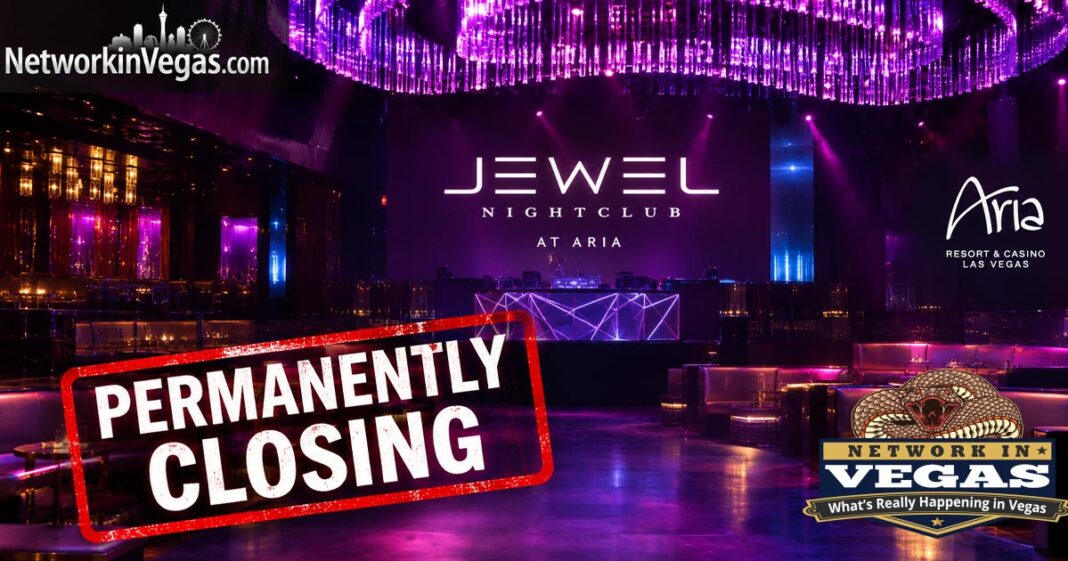
Jewel Nightclub at Aria is shutting down for good after its final night on Saturday, November 21, bringing an end to another piece of the Las Vegas nightlife scene. The closure comes at the end of Formula 1 race weekend, giving the club one last shot at the crowds willing to spend outrageous amounts of money for a night on the Strip.
MGM Resorts says there are no immediate plans for the roughly 24,000-square-foot space. Instead, the company is directing guests toward Easy’s, Lift Bar, and the newly renovated Alibi, scheduled to reopen November 13.
Think about what that means. Aria is losing a nightclub built to hold nearly 2,000 people, complete with DJs, dance floors, celebrity appearances, and bottle-service tables. Its replacement, at least for now, is a collection of lounges and cocktail bars where people can sit around drinking.
That’s quite a downgrade for a city that built its reputation on being the place where the party never stops.
Jewel opened in May 2016 under Hakkasan Group, which Tao Group acquired in 2021. It became one of the Strip’s more prominent hip-hop-focused clubs, hosting performances by Usher, championship celebrations for the Golden State Warriors, and the Las Vegas Aces’ 2023 title party. For years, it was part of the machine that made Las Vegas nightlife famous.
But by 2026, plenty of Las Vegas locals hearing about the closure had the same reaction: Jewel was still open?
That probably tells you everything you need to know about where the club stood in the increasingly crowded and expensive Las Vegas nightlife market.
Neither MGM nor Tao has publicly identified a specific reason for shutting it down. We’re not going to pretend we know what happened behind closed doors, but we aren’t going to ignore the larger problems facing the industry, either.
Las Vegas nightlife has become an increasingly expensive business to operate, an increasingly dangerous one when the wrong crowds show up, and one that faces a serious question about where its next generation of customers will come from.
The Violence Problem Las Vegas Nightlife Doesn’t Want to Talk About
Before Jewel, the same space at Aria was home to Haze Nightclub, and that location has a history nobody at MGM should be eager to revisit.
In February 2013, an argument connected to a private party at Haze spilled into the resort’s valet area and eventually turned into one of the most horrific shootings in modern Las Vegas Strip history.
Ammar Harris opened fire from a Range Rover at a Maserati driven by Oakland rapper Kenneth “Kenny Clutch” Cherry Jr. on Las Vegas Boulevard. Cherry was killed, his car crashed into a taxi, and the taxi caught fire, killing the driver and a passenger.
Three people were dead because of a confrontation that began around a nightclub event. Harris was convicted in 2015, and one victim’s family subsequently sued Aria, Haze, and Harris, alleging negligence and failures in supervision.
The shooting itself happened on Las Vegas Boulevard, but the legal fallout reached the nightclub and resort.
Then, in September 2020, Aria’s valet area was again the scene of a shooting connected to a rapper’s birthday celebration.
Police said an event involving Moneybagg Yo moved outside to the valet, where the rapper was supposed to receive a car as a birthday gift. An estimated 80 to 100 people gathered, a fight broke out, and someone was shot in the leg. Video spread across social media, bringing another round of national attention to violence outside one of the Strip’s luxury resorts.
These weren’t random incidents in an alley miles from the casinos. They involved crowds connected to nightlife events spilling into one of the most visible entrances of a major Las Vegas resort.
And that’s where the financial problem starts.
A nightclub might make a fortune selling $10,000 tables to celebrities, athletes, and their entourages, but one confrontation that turns into gunfire can expose the entire property to lawsuits, negative publicity, heightened security costs, and a public-relations nightmare.
Most people going to these clubs aren’t looking for trouble. They’re there to party, celebrate, and spend money. Unfortunately, it only takes a handful of idiots with a grudge, a weapon, or something to prove to destroy an entire night for everyone else.
We don’t know whether those earlier incidents had anything to do with Jewel’s closure. But any casino executive looking at the long-term costs of operating a nightclub has to consider what happens when the crowd outside becomes a bigger problem than the party inside.
When One Fight Can Cost $56 Million, Nightclubs Become a Serious Liability
It’s not just the shootings that nightlife operators have to worry about. Nevada’s legal environment is making security failures potentially devastating for businesses.
A Clark County jury recently awarded $56.5 million to Navy veteran Omar Alrabadi, who suffered a traumatic brain injury after being beaten and stomped near the LINQ Promenade in 2021.
Caesars Entertainment and the bar were named in the lawsuit. Alrabadi’s attorneys argued that security personnel pushed him toward his attackers and failed to call 911. The case also involved missing evidence, with the judge allowing jurors to draw an adverse inference over evidence the bar failed to preserve.
That kind of verdict gets attention throughout the hospitality industry.
Insurance companies don’t care how famous the DJ is or how much a nightclub charges for a bottle of vodka. They’re looking at exposure, security incidents, previous claims, and the possibility that one violent confrontation could turn into a multimillion-dollar lawsuit.
Specialty insurers have identified Nevada nightlife and security accounts as difficult risks, pointing to assault-and-battery claims, the volume of people moving through entertainment properties, and litigation costs.
For the major clubs bringing in enormous amounts of revenue, those expenses might be manageable. For a smaller nightclub fighting for market share against the Strip’s biggest venues, the calculation becomes much harder.
You still need the same expensive security operation, crowd control, liability coverage, and staff to handle the one night when everything goes wrong. But you may not have the consistent revenue to justify those costs.
Eventually, the nightclub stops looking like a profitable amenity and starts looking like an unnecessary risk.

And if the casino can make money from the same customers sitting in a controlled cocktail lounge without dealing with a thousand people pouring onto a dance floor, it’s not hard to see why that option might become more attractive.
Las Vegas Keeps Letting the Worst Crowds Destroy Things for Everyone Else
We’ve been covering this problem for years, and it’s getting harder to ignore how often the same pattern appears at completely different types of venues.
When we reported that Cowabunga Bay was closing after 12 years, sources pointed toward ongoing problems with unruly crowds and violence.
In May 2025, a massive fight at the water park ended in a shooting. This spring, the park canceled additional Great Grades Day events after students caused problems at the first one. We’ve also seen repeated trouble involving groups of teens at Downtown Summerlin and Meadows Mall.
Cowabunga Bay’s owners never confirmed that violence was the reason for closing, but the larger issue is obvious. How long can a family-oriented business keep operating when parents start wondering whether taking their kids there is worth the risk?
Then came the October shooting at First Friday.
As we reported in Somebody Got Shot at First Friday Again. The City Saw It Coming., three people were shot, including a teenager who died.
Metro had already been dealing with guns, fights, and increasingly disruptive crowds at the monthly arts event. Police said they were recovering at least one illegally concealed gun at nearly every First Friday. Juvenile arrests and citations reached 78 in May, before increased enforcement helped bring that number down to 18 by August.
An event that should have been about local artists, music, restaurants, and downtown businesses had become another place where police needed extra resources to keep troublemakers under control.
Now Jewel is closing. We’re not claiming that the club is shutting down because of violence, and the documented incidents at Aria are not proof of its current operating conditions. But the same broader question applies to all three situations: How much trouble are businesses and paying customers expected to tolerate before the experience stops being worth it?
A handful of people looking to fight, intimidate others, or settle disputes can ruin an event that thousands of normal people enjoy.
The people who suffer aren’t just the owners. They’re the employees who lose hours or jobs, the nearby businesses that lose customers, and the families and tourists who decide they’d rather stay home than deal with the bullshit.
Metro’s 2025 figures showed violent crime declining overall in Las Vegas, and that’s good news. But declining crime statistics don’t erase the impact of a shooting that goes viral across the country.
For a city dependent on convincing people to spend their hard-earned money here, perception matters. Someone in California planning a weekend in Vegas isn’t necessarily studying Metro’s annual crime report. They’re looking at videos on social media and deciding whether the trip sounds like fun anymore.
Even Without the Violence, Las Vegas Nightclubs Have Another Problem: Young People Aren’t Buying What They’re Selling
The security issue is only one side of the problem. The other is arguably worse for the long-term future of Las Vegas nightlife.
The next generation of customers isn’t nearly as interested in drinking and partying as the industry needs it to be.
According to Gallup, just 54% of American adults say they drink alcohol, the lowest share recorded in nearly 90 years of polling. Among adults ages 18 to 34, only about half report drinking, a nine-percentage-point drop since 2023.
For the first time in Gallup’s tracking, a majority of Americans, 53%, now believe even moderate drinking is bad for their health. Among younger adults, that figure is roughly two-thirds.
And it’s not just alcohol.
A Harris Poll released this summer found that 68% of Gen Z respondents believe going out isn’t worth the money it costs. Industry figures also suggest that Gen Z accounts for only about 4% of U.S. alcohol dollar sales.
Think about how disastrous those trends could become for the traditional Las Vegas nightclub business model.
These clubs were built around customers willing to spend $20 to $30 on drinks, hundreds of dollars on entry and table minimums, and thousands of dollars on bottle service. The entire system depends on people believing that spending a ridiculous amount of money for a few hours inside a crowded nightclub is worth it.
Now an increasing share of the generation expected to replace older customers is questioning both the drinking and the spending.
That doesn’t mean Gen Z never goes out, and it certainly doesn’t mean every nightclub is doomed. The biggest venues with the hottest DJs, powerful brands, and international customers can still draw enormous crowds.
But it does mean the industry can’t automatically assume that every new generation of 21-year-olds will behave like the previous one.
And Las Vegas has done itself no favors by making almost every part of a night out more expensive.
The Strip Is Pricing Out Its Future Customers While Killing Off What Made Vegas Famous
We warned about this exact problem in August in The Death of 24-Hour Las Vegas Is Coming Back to Bite the Strip, and Gen Z Sure as Hell Isn’t Helping.
Las Vegas visitation dropped 7.5% in 2025 to approximately 38.5 million people. At the same time, the Strip has increasingly focused on higher-income travelers willing to spend more money per visit.
The share of Las Vegas visitors reporting household incomes above $100,000 has climbed dramatically compared with 2019, as resorts increasingly chase customers who can afford expensive rooms, high-end dining, VIP experiences, and premium entertainment.
From a short-term financial standpoint, the strategy isn’t difficult to understand. Why cater to a crowd spending $100 when you can attract someone willing to spend $1,000?
The problem is what happens when you build an entire city around that mentality.
Las Vegas used to give people a reason to come here even when they weren’t wealthy. You could find cheap food in the middle of the night, inexpensive drinks, free attractions, affordable shows, and enough entertainment to keep yourself busy without taking out a second mortgage.
A younger visitor could come to Vegas, have an incredible weekend without spending a fortune, and spend the next decade looking for reasons to return.
Today, between resort fees, parking charges, expensive restaurants, inflated drink prices, and entertainment that costs more than a lot of people spend on an entire weekend vacation, Vegas is increasingly telling those customers they’re no longer wanted.
And then the industry acts surprised when younger people aren’t coming.
Jewel’s closure fits into that larger shift. Instead of a massive nightclub designed around crowds, music, and a high-energy party atmosphere, Aria is steering guests toward smaller, more controlled lounges and bars.
For MGM, that may make financial sense. For Las Vegas as an entertainment destination, it’s another reminder of how much the city is changing.
Las Vegas Is Losing the Party That Made It Famous
Nobody is going to pretend Jewel was the center of Las Vegas nightlife in 2026. The fact that so many locals barely remembered it existed says plenty about its place in the market.
But the closure represents something bigger than one nightclub losing its lease on the Strip.
Las Vegas is becoming a city where operating large entertainment venues comes with enormous costs, where one violent incident can trigger years of legal problems, and where the customers who once supported the nightlife business are getting older while their potential replacements are drinking less and questioning whether the experience is worth the price.
Meanwhile, casino operators have grown increasingly comfortable replacing the unpredictable, messy, all-night atmosphere that made Vegas famous with something safer, more controlled, and easier to monetize.
Some of that change is understandable. Businesses need to make money, and nobody should expect a resort to keep a nightclub open simply because it was popular a decade ago.
But there’s a real danger in turning Las Vegas into a collection of luxury hotel lobbies, overpriced restaurants, and reservation-only experiences for people with unlimited disposable income.
You can make a casino safer, more predictable, and more profitable on paper while slowly stripping away the reasons people wanted to visit in the first place.
Jewel gets one final Formula 1 weekend before the lights go out November 21. MGM hasn’t announced what’s coming next.
Maybe another nightclub eventually takes its place. Maybe the space becomes a restaurant, lounge, or something entirely different.
Whatever happens, Las Vegas should be paying attention to the bigger problem. The city is losing pieces of its nightlife identity while making it increasingly difficult for a new generation of customers to discover why Vegas was worth visiting in the first place.
And once those customers find somewhere else to spend their money, getting them back is going to be a hell of a lot harder than closing another nightclub.