
“There Is No Privacy When You Drive Down the Street”
Clark County’s sheriff has made his peace with the surveillance grid. The rest of Las Vegas was not asked.
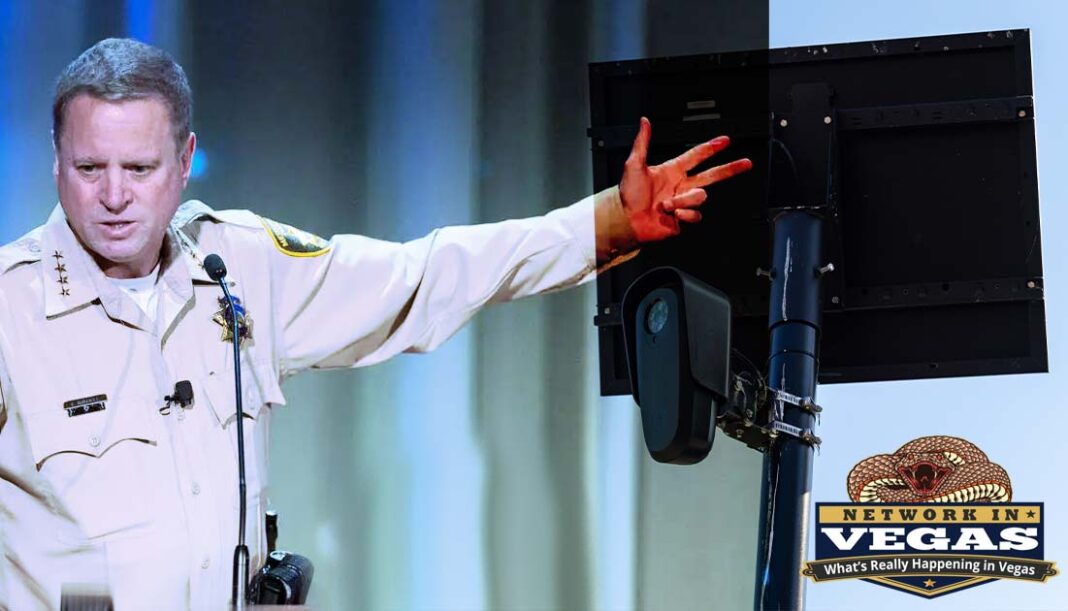
Sheriff Kevin McMahill wants Las Vegas to know he’s comfortable with the controversial tracking and surveillance grid. Asked about the automated license plate readers now blanketing the valley, he told the Review-Journal that he doesn’t care for the big-brother aspect of it, but that he’s a realist — and, in his words, “there is no privacy when you drive down the street.”
That sentence deserves more scrutiny than it got. It is not a description of the law. It also doesn’t jive with our Fourth Amendment, but it happens to be the same argument the federal government has been making in court while judges, senators, and residents in dozens of cities go the other way.
What’s actually deployed here in Las Vegas
The numbers McMahill provided are worth writing down, because most people in this valley have never seen them.
Metro operates roughly 180 Flock Safety cameras and about 130 Motorola units. It also draws on more than 300 additional cameras run by private companies, apartment complexes, and neighborhood watch groups. Every plate that passes gets logged — number, timestamp, location, direction — and held for 90 days.
Metro’s own transparency portal, as of early August, showed 4,706 searches in 30 days against 2,411,401 unique plate reads in that same month. Two and a half million cars photographed and catalogued, in a county of roughly 2.3 million people.
Note the retention figure. Ninety days. Under pressure this summer, Flock itself dropped its default retention to seven days — a change the ACLU called inadequate, since customers can override it. Norfolk, Virginia, the city at the center of the biggest constitutional fight over this technology, holds data for 21 days, and only because Virginia law caps it there. Nevada has no such cap. Metro chose 90 days on its own, and can change it on its own, and nobody voted on it.
The “just a license plate” defense
McMahill’s core reassurance is that this isn’t facial recognition — that all he gets is a time, a location, a general description, and a plate.
That’s true and it’s beside the point. The Fourth Amendment concern was never that a camera recognizes your face. It’s that a network of cameras, queried against a database, reconstructs where you have been. Norfolk’s own police chief was more candid about the design goal than McMahill has been: he described the deployment as “a nice curtain of technology” that would make it difficult to drive any real distance without hitting a camera.
The watchdog site deflock.org notes that these systems also capture make, model, color, and identifying details like dents, roof racks, and bumper stickers, converting them into searchable data points. A “vehicle fingerprint,” in Flock’s own terminology. You can be found without your plate ever being read correctly.
And the Electronic Frontier Foundation, reviewing datasets covering more than 12 million searches by some 3,900 agencies between December 2024 and October 2025, found hundreds of queries tied to political demonstrations, including the No Kings protests. It also documented a Texas sheriff’s office running a search logged as a missing-person case that was, in fact, about an abortion.
The constitutional question is not settled
McMahill talks like the legal debate is over. It isn’t.
In 2025, a federal judge in Virginia let a challenge to Norfolk’s 176-camera network proceed, writing that a reasonable person could conclude the system violates the privacy expectations the Supreme Court laid out in Carpenter v. United States — the 2018 decision requiring a warrant for historical cell-site location data. The plaintiffs, a Navy veteran and a home healthcare worker represented by the Institute for Justice, had been photographed 475 and 325 times respectively over four months.
In January, the same judge reversed course and dismissed the case, reasoning that Norfolk’s network wasn’t extensive enough to track “the whole of a person’s movements.” Flock’s chief legal officer promptly noted that more than 30 courts have reached similar conclusions about fixed-location readers.
But the case is on appeal at the Fourth Circuit as Schmidt v. City of Norfolk, with the ACLU and EFF filing in support. And in the meantime the Supreme Court decided Chatrie v. United States, holding 6-3 that obtaining a person’s cell-phone location data is a search — and specifically rejecting the government’s argument that pulling a narrow slice of a much larger dataset makes it constitutionally fine. That reasoning maps uncomfortably well onto a plate-reader query.
Meanwhile, the federal government filed a statement of interest siding with Norfolk, arguing on the strength of decades-old precedent that no American can reasonably expect privacy on a public road.
Which is, word for word in substance, the sheriff’s position. He is not stating an obvious truth. He is taking a side in an unresolved fight, on behalf of 2.3 million people who were not consulted.
What the CEO actually said
Flock’s founder and CEO, Garrett Langley, has spent August on a media tour trying to slow the backlash. He hasn’t quite told Americans to give up their privacy, but he’s come close enough that the distinction is thin.
His pitch is that the country has to stop choosing: “what we have to prioritize as a country is compromise.” He says he values his own privacy. He compares banning the technology to banning cars over crash risk.
The more revealing line came at a TED talk in April, where — weighing misuse of his product against the investigations it assists — Langley called it “a trade-off I can make.”
He can make it. That’s the trouble. The trade-off is his to make and yours to absorb.
The abuse isn’t hypothetical
A Washington Post investigation this month identified at least 50 law enforcement officers charged with or accused of misusing plate-reader systems; Flock’s equipment was involved in 46 of those cases. In 26, investigators said officers were spying on wives, girlfriends, exes, exes’ new partners, or women they wanted to meet.
A Georgia police chief allegedly searched his ex-girlfriend’s plate — and her teenage daughter’s — around 600 times. A Wisconsin officer allegedly checked whether an ex had visited an abortion clinic. A former California deputy got six years for a stalking campaign against his ex-fiancée. Several others got probation.
Most of these departments hadn’t looked. The audit logs Flock points to as its accountability mechanism generally get reviewed only after somebody complains. A follow-up Post story found officers whose misuse their own departments were unaware of until reporters asked.
And then there’s who paid for it
Metro’s cameras were not bought with appropriated public money that anyone could vote against. McMahill confirmed a number of the Flock systems came through private donations to the LVMPD Foundation and Behind the Blue.
The Review-Journal reported in 2024 that the plate readers arrived here after the venture firm Andreessen Horowitz donated money toward the purchase of public safety technology from the firm’s own portfolio companies — a fact Ben Horowitz posted about himself.
Andreessen Horowitz is an investor in Flock Safety, which last year raised $275 million at a $7.5 billion valuation.
So: a venture capital firm donated money to a police department, which the department used to buy equipment from a company that firm holds a stake in, deploying a surveillance network across a metropolitan area with no public hearing, no ordinance, and no budget vote. Then the sheriff explains that privacy on public streets doesn’t exist anyway.
The other side of the story…
There is a real argument for these cameras. Flock says its technology supported more than a million investigations last year and helped locate over 10,000 missing people. Detectives here will tell you, credibly, that plate hits have closed cases that would otherwise be open. Nobody serious disputes that the tool works.

But “it works” has never been the standard. Warrantless searches of houses would work too. The question a sheriff is supposed to answer is what limits apply, who set them, and who can enforce them — and on that, McMahill has offered assurances rather than rules: Metro won’t share with ICE, won’t target people for their politics or religion, will use the data only for law enforcement.
Every one of those is a policy the department wrote for itself and can rewrite for itself, tomorrow, without telling anyone.
Beryl Lipton of the EFF put the objection about as fairly as it can be put: this isn’t a decision law enforcement gets to make unilaterally, without community input and without officials understanding the trade-off they’re accepting.
McMahill is right that you can be seen on a public street. He is wrong that being seen is the same thing as being catalogued, stored for three months, and made searchable by 4,706 queries a month with no warrant and no judge. The Framers didn’t have a word for the difference. The Fourth Circuit is working on one.