Nevada will give up 50,000 acre-feet of Colorado River water each year under new federal rules. Las Vegas can handle that for now. What comes after 2028 is a much bigger question.
The federal government made it official Friday: Nevada is losing 50,000 acre-feet of Colorado River water a year in 2027 and 2028.
That works out to nearly 17 percent of Nevada’s entire 300,000 acre-foot allocation, already the smallest share handed to any of the three Lower Basin states.
For Las Vegas, the immediate news isn’t quite as apocalyptic as the number sounds. Southern Nevada has spent more than two decades squeezing more out of its tiny Colorado River allotment, recycling indoor water and cutting consumptive use enough that the valley should be able to absorb the reduction without anyone turning on the kitchen faucet and finding nothing coming out.
But that doesn’t mean Friday’s decision is nothing to worry about.
The bigger story is what forced the federal government to make the cuts in the first place. Lake Mead and Lake Powell are sitting at record lows, the Colorado River just suffered through its worst snowpack on record, and federal officials are now rewriting the rules for a river that supplies roughly 40 million people across the West.
And Las Vegas gets about 90 percent of its water from that system.
Nevada gets the smallest cut, but it also started with the smallest piece
Interior Secretary Doug Burgum signed the new 2027-2028 Colorado River operating guidelines Friday, establishing the first set of rules under a broader federal framework that will govern Lake Mead and Lake Powell through 2036.
For each of the next two years, the three Lower Basin states are expected to reduce Colorado River deliveries by a combined 1.25 million acre-feet.
Under the sharing agreement proposed by Arizona, California and Nevada, those reductions break down like this:
- Arizona: 760,000 acre-feet
- California: 440,000 acre-feet
- Nevada: 50,000 acre-feet
The states are also expected to voluntarily conserve and store at least another 700,000 acre-feet over the two-year period.
Meanwhile, Colorado, New Mexico, Utah and Wyoming will not face the same mandatory Lower Basin delivery cuts. Instead, Interior is directing the Upper Basin states to work on reservoir operations at Flaming Gorge, Navajo and the Aspinall Unit that could be used to help keep Glen Canyon Dam functioning.
That split has been one of Nevada’s biggest complaints throughout this process. State officials have repeatedly argued that you cannot fix a river shared by seven states by demanding mandatory reductions from only three of them.
Lake Mead is lower than it has ever been
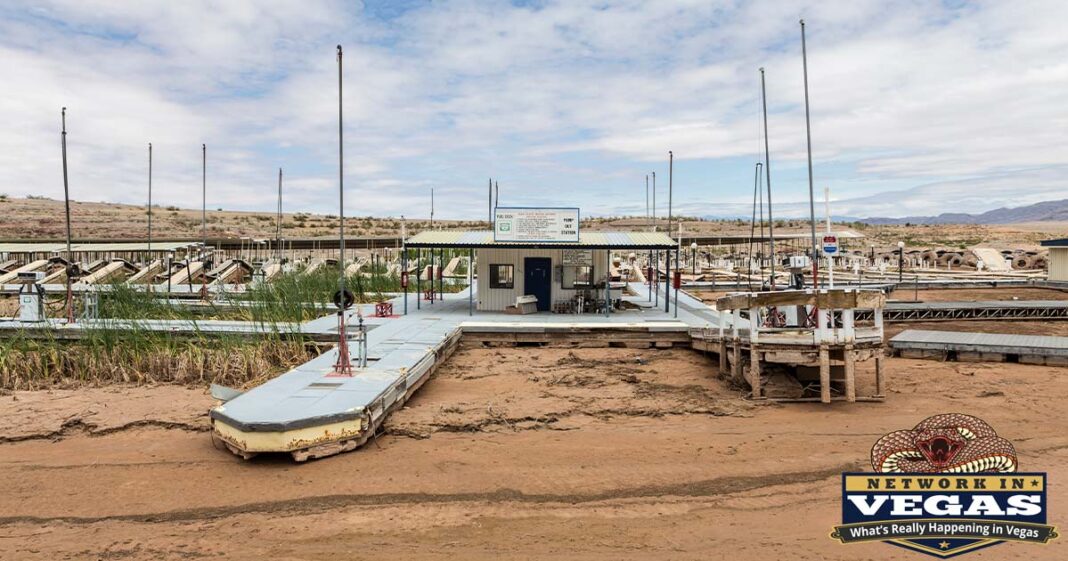
There is no mystery about why the federal government finally pulled the trigger. Lake Mead hit the lowest level ever recorded on Aug. 7, dropping to 1,040.50 feet. Nine days later, Lake Powell broke its own record, falling to 3,519.91 feet on Aug. 16. Interior noted that combined storage in the two reservoirs hasn’t been this low since before Powell started filling in 1963.
Reclamation blamed a familiar culprit: 26 years of drought, made worse in 2026 by the lowest snowpack ever observed in the basin during the 2025–26 winter.
The August 24-Month Study released the same day sets Powell’s starting elevation for the water year that begins Oct. 1 somewhere between 3,540 and 3,510 feet. That drops the reservoir into what Reclamation calls the Lower Elevation Infrastructure Protection Range, with releases initially expected between 6 and 7 million acre-feet. The agency will throttle those releases month by month to try to hold 3,510 feet — the floor for reliable operations at Glen Canyon Dam — and won’t settle on a final annual volume until April.
No, Las Vegas is not about to run out of water
This is where the story needs some perspective, because every time Lake Mead drops another few feet, somebody inevitably starts claiming Las Vegas is about to become the next abandoned desert ghost town.
Southern Nevada draws about 90% of its water from Lake Mead, but the valley has been using far less than its allocation for years. SNWA has reported consumptive use around 198,000 acre-feet, well under the 250,000 the state will be allowed in 2027. Recycling is the reason: nearly every drop that goes down an indoor drain in the valley gets treated and returned to Lake Mead through the Las Vegas Wash, and Nevada gets credit for it.
The authority has also already been operating as if the cut were coming. At its board meeting Thursday, directors ratified an agreement with Reclamation that pays Nevada $16.25 million to leave 50,000 acre-feet in Lake Mead this year — the same volume the new guidelines now require going forward.
State officials pushed back hard when the framework was previewed on July 31. Gov. Joe Lombardo said the plan sought to impose “unrealistic reductions” on Nevada water users. SNWA General Manager John Entsminger, the state’s lead river negotiator, called the approach “fundamentally flawed” while acknowledging Nevada can absorb the short-term reductions.
Both said they remain committed to a seven-state consensus deal. Interior left the door open for one, saying any agreement the states reach could be folded into future operating guidelines.
Reclamation is holding a public webinar on the decision Friday at noon Mountain time.
Nevada was already being paid to leave that much water in the lake
There is another detail that shows how prepared Southern Nevada was for a cut of this size.
In July, the Southern Nevada Water Authority approved an agreement with the Bureau of Reclamation that allows Nevada to create up to 50,000 acre-feet of system conservation water in exchange for as much as $16.25 million in federal funding.
In other words, Nevada was already preparing to leave roughly the same amount of water in Lake Mead that the new federal guidelines are now taking off the table.
That does not make the federal reduction meaningless. It does show why local water officials have been saying for years that Southern Nevada is in a better position than many other Colorado River users to withstand the first round of shortages.
The problem is that nobody knows where the first round ends.
2029 is where this gets a lot more interesting
Friday’s decision gives Nevada something it desperately needed: certainty for the next two years.
It does not give Las Vegas much certainty after that.

Interior’s new framework runs through 2036, but the actual operating rules can be rewritten in roughly two-year chunks depending on reservoir levels, hydrology, negotiations among the states and whatever voluntary conservation agreements are reached.
That means the 50,000 acre-foot Nevada reduction is not necessarily the new permanent number. If the river continues deteriorating, the cuts can get considerably deeper.
Federal modeling released during this process examined Lower Basin reductions reaching as high as 3 million acre-feet per year under severe conditions. Previous scenarios showed Nevada potentially losing more than 100,000 acre-feet of its 300,000 acre-foot allocation.
That starts putting Southern Nevada a lot closer to the amount of water it actually consumes.
And unlike Arizona and California, Nevada does not have a giant agricultural sector it can squeeze before the Las Vegas Valley starts feeling the consequences. Almost the entire Nevada allocation exists to keep Southern Nevada running.
That is why Gov. Joe Lombardo blasted the federal framework when it was released in July, saying it sought to impose “unrealistic reductions” on Nevada and warning that deeper cuts could have serious economic consequences.
SNWA General Manager John Entsminger, Nevada’s lead negotiator on the Colorado River, was just as critical, arguing that any system built around major mandatory reductions for only three of the seven basin states is fundamentally flawed.
Nevada officials are still pushing for a seven-state agreement before the next round of operating rules is written. Interior specifically left room for such a deal to replace or modify parts of the federal framework.
Whether seven states that have spent years fighting over who should give up what can finally agree is another question.