The Raiders want up to $75 million in public money for a new entrance plaza at a stadium that opened just six years ago. The project may make sense. The question nobody seems very interested in asking is why the public should have to pay for it.
Allegiant Stadium is only six years old.
It cost roughly $2 billion to build, including a record-setting $750 million public contribution from Southern Nevada. That money wasn’t an investment that bought taxpayers a piece of the Raiders. It wasn’t a loan that Mark Davis eventually has to pay back. The public contribution was financed through hotel room taxes, with more than $1 billion ultimately being collected to cover the debt tied to the stadium deal.
Now the Raiders are back begging for more money from tax payers.
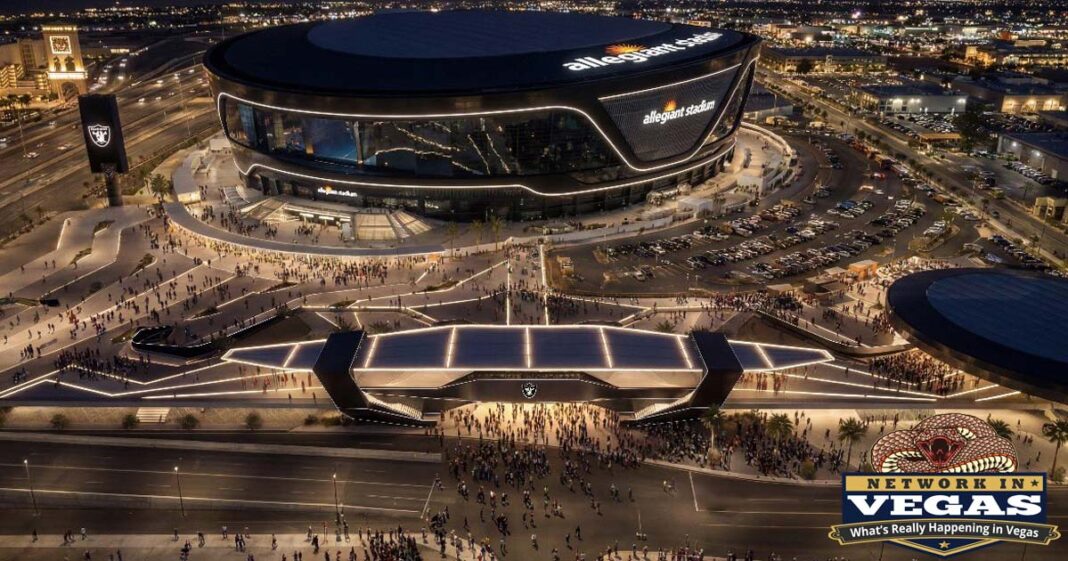
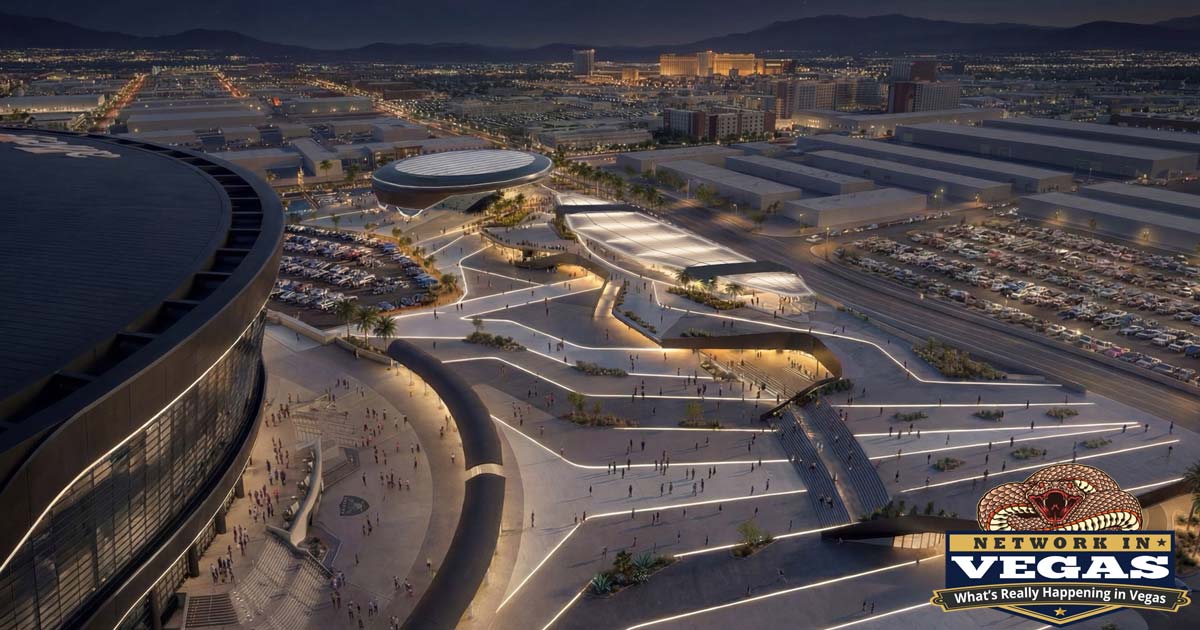
At Thursday’s Las Vegas Stadium Authority meeting, team president Sandra Douglass Morgan presented plans for a $158 million North Plaza Project designed to fix congestion on the north side of Allegiant Stadium. That’s where huge crowds make their way across Hacienda Avenue from the Strip before and after Raiders games, concerts and other major events.
Morgan described the area as one of the stadium’s biggest “pressure points” and said the existing infrastructure can be stretched to capacity during large events.
The proposed solution is substantial. Plans call for an elevated pedestrian deck connecting the Hacienda approach directly into a new plaza, event space, shade structures, a dedicated rideshare operation below the deck and accommodations for future transportation options, including a Vegas Loop station.
The Raiders want the public to kick in up to $75 million to help build it.
The team would cover the remaining $83 million. Apparently $750 million didn’t include the front door or a way for people to get to the stadium.
At the same time they are begging for taxpayer dollars, the Raiders are paying five ex-coaches roughly $50 million to not coach — Carroll, McDaniels, Gruden, Pierce, and the offensive coordinator they fired mid-season. Yep, you heard that right, the team is carrying somewhere around $50 million this season in salaries owed to people who no longer work here. Pete Carroll, fired after one 3-14 season with two years left, is owed roughly $16 million. Josh McDaniels, fired in 2023, is still collecting on a six-year deal in the neighborhood of $10 million a year while working as an offensive coordinator in New England. Jon Gruden’s 2018 contract was ten years and nearly $100 million; he was owed close to $40 million when he resigned in 2021, and the settlement terms were never made public. Which is worth saying plainly: the $50 million is a reported estimate built partly on undisclosed figures, not an audited number.
If you have that kind of money to spend on your own mistakes, you have that kind of money to spend on your own entrance.
Meet the Waterfall Residual Fund
Nobody walked into Thursday’s meeting carrying a giant novelty check that said TAXPAYERS on it. The money would instead come from something called the Waterfall Residual Fund, which sounds wonderfully harmless until you remember where the money comes from.
Hotel room taxes.
The basic setup is that room-tax revenue flows through a list of obligations connected to the stadium. Bond payments get made. Other required expenses get covered. Money goes toward things such as UNLV payments, Stadium Authority operations and required stadium capital funding. Whatever makes it all the way to the bottom of that waterfall can land in the residual fund.
State law allows residual money to be used for capital improvements at Allegiant Stadium. Steve Hill, who heads the LVCVA and chairs the Stadium Authority, made that point Thursday.
But there’s another part of the law that deserves just as much attention: stadium improvements aren’t the only thing that money can be used for.
Residual funds can also go toward public infrastructure around the stadium or toward retiring the stadium debt early. Clark County, for example, has already identified millions of dollars in street-signage improvements around the area.
Would any other business get to do this?
Strip away the NFL logos for a minute and look at this like any other business.
As many online have pointed out, imagine Costco opens a giant new store. Business is fantastic. The place is packed every weekend, revenue is pouring in and six years after opening the company realizes the entrance area wasn’t designed particularly well for the number of customers showing up.
So Costco films the traffic jam, puts together some slick architectural renderings and heads down to a government meeting asking the public to pay nearly half the cost of a $158 million new entrance complex.
What would your first question be?
Probably something along the lines of: Why the hell isn’t Costco paying for Costco’s entrance?
That question doesn’t magically become unreasonable because the customers are wearing Raiders jerseys.
The Las Vegas Raiders are now valued at around $11 billion. Allegiant Stadium has become one of the most important event venues in the country. It hosts NFL games, UNLV football, massive concerts, major college sporting events and another Super Bowl is coming in February 2029.
This is not a struggling community facility trying to patch a leaking roof. This is one of the crown jewels of the Las Vegas entertainment economy asking the public to help finance another major capital improvement.
“World-class venue” is doing a lot of work here
Steve Hill, who runs the LVCVA and chairs the Stadium Authority, framed it this way: the Stadium Authority technically owns the building, the Raiders are responsible for its upkeep, and everyone wants to make sure it stays, in his words, “a world-class venue.”
Meanwhile: the stadium hosted 38 ticketed events over the last 12 months. It has been one of the highest-grossing concert venues on the planet. Super Bowl LXIII lands here in February 2029, which — surprise — is the deadline driving this timeline. The building works. It prints money. Taxpayers don’t see a dime of the profit, only the bond payments.
The success of Allegiant Stadium was supposed to be the argument for why the subsidy was smart. Instead it’s now being used as the argument for a second one.
The part that should worry you most
There were no arguments against the $75 million on Thursday. None. Not from a single board member, not from the public.
The room was mostly Raiders staff and Athletics staff. As LVSportsBiz has pointed out, the team is asking for $75 million while releasing almost nothing to the public about the project’s specifics. Renderings dropped, applause happened, and the item moved along.
No vote was taken — items can’t be introduced and approved at the same meeting. The vote is tentatively set for a special Stadium Authority meeting on September 2.
That’s your window. It’s a narrow one, and it’s scheduled at the tail end of summer when nobody’s paying attention, which is exactly when things like this tend to pass.
In fairness
The case on the other side isn’t nothing. The north entry genuinely is a mess, and a crowd crush is a safety issue, not just an inconvenience. The plaza will be publicly accessible, not luxury boxes. It connects to transit infrastructure the whole corridor could use. The money comes from a tax paid overwhelmingly by visitors rather than by residents, and the fund is running ahead of projections. Supporters will tell you the Super Bowl and the concert calendar pump money back into the valley either way, and they can point to real numbers.
Fine. Make that case. Publicly, with the documents attached, in front of people who don’t work for the team.
That’s all any of us are asking for. Not a veto — a conversation. Because right now the position of the richest tenant in Southern Nevada appears to be that $750 million bought a stadium, and the entrance now costs extra.
Meanwhile, The A’s have spent $600M so far on the construction of their Las Vegas ballpark. They are expected to ask the public for more money sometime in 2027.